Tuesday, July 24, 2012

Name Post: Voices of Iceland


I think I just had my last interview of the year. It’s the last one I have scheduled, anyway, and I want to keep it that way and hoard these last few days all to myself.  I still don’t know what (if anything) is to come of all of the conversations of this year or of my own relationship to this research and to this topic. I seem to fluctuate wildly between thinking I should go home and write a book with all of it immediately, and wanting to shut the cover of my black notebook and lay it to rest as this year comes to an end.
                And it has. When Katie and Isa were visiting me at the very beginning of my time in Iceland, we talked about how this topic is impossible to study without talking to people. You can’t (usually) learn someone’s name through observation alone. It requires a conversation, and, if the conversation is to be at all interesting or revealing, it requires a connection.  Studying names has given me a reason to talk to people, and a reason to travel. Even if those were the only reasons for studying names, they’ve made it a worthwhile topic.  
My last few weeks in Iceland have been filled by a steady flow of these conversations. I’m still working on how they all fit together, but I also think that in some ways, that’s what the Icelandic naming committee is currently figuring out too--how these different aspects of a changing Icelandic population work, where the lines are between cultural insularity and cultural acceptance, what it means to carry a name that breaks linguistic and grammatical rules, and if that even matters. I’m breaking down my recent interviews (the ones I haven't written about yet) into brief descriptions of what I think were their most interesting moments below.  Hopefully this gives you a sense of the questions that arise in discussing what constitutes an Icelandic name in 2012. 
 
Outdoor art in downtown Reykjavik


 Monument to civil disobedience outside the parliament to commemorate the protests following the 2008 economic crash.

 Sara & Olga
                 
               Sara & Olga are two sisters who live out in Hafnarfjarðar. I met with them a few weeks ago and they kindly gave me breakfast and some pretty adorable babies to hold (it was all in all a great morning). They have three daughters between them and we talked about how they chose their names. 
              Sara’s daughter, Rafnhildur Sjorn, is six weeks old. She was going to be called “Marta” or “Isabella” until Sara took a look at her jet black hair and fierce, determined eyes. Rafnhildur is an old Valkyrie name that comes from the words “raven” and “battle.” The name “Sjorn” is Sara’s mother’s name. 
                Olga has two daughters, four year-old Úlfhildur Sjorn (the Sjorn again after her mother, and Úlfhildur meaning “battle of the wolves”), and one year-old Salvor Vega (Salvor meaning “sun season”).  She told me it’s taken her a while to decide on both of her daughters’ names. (Úlfhildur wasn’t named until she was six weeks old).  She felt it was a great responsibility, she told me. She said that she kept wondering, if “a baby makes a name, or a name makes a baby.” 
               Sara and Olga spent a large part of their childhoods in Sweden, and they said that at times their Icelandic names posed challenges.  Like in most Icelandic families, their names followed the patronymic system, which meant they all had different last names. In Sweden, their whole family decided to go by their father’s last name to make things less complicated. Olga also told me that in school she was self-conscious about being the only girl with her first name. “I really hated it,” she told me. “But then I started realizing that teachers always remembered it. I was the only Olga, and I got to make up what that name meant.” 
                We talked a bit about the patronymic system and how it worked. It struck me for the first time that Iceland was a place where, if you took your mother’s name, it was quite obvious.  In the states, if you go by your mother’s last name instead of your father’s, it can easily go unnoticed (“Smith” and “Garcia”, for example, are genderless, and could have come from either parent). In Iceland, however, since surnames are derived from first names, and first names are regulated by gender, a baby named  with the last name “Helgasdottir” as opposed to “Jonssdottir” would clearly be going by her mother’s name. There may be some stigmas surrounding this (stigmas that are starting to change as more and more people are opting to use the matrynomic).  Traditionally, however, having your mother’s last name could be an indication either that you have a radical feminist for a mother, or, to the delight of the gossiping Icelandic countryside, the father’s identity is unclear. 
                I recently heard a story that during World War II when there were many American and British soldiers in Iceland, many babies were being born to Icelandic women with the last name “Hermatthson” or “Hermathsdottir.” In Icelandic, “hermaður“ is the word for soldier, so these invented surnames conveinently left the identity of their non-Icelandic fathers unknown. 
                We got on this topic because Sara is raising Rafnhildur Sjorn on her own. Her full name is Rafnhildur Sjorn Sarasdottir.  We wondered whether Rafnhildur would face people making assumptions about her based on her surname, or whether by the time she’s going to school, it will be more commonplace. 
                Sara and Olga are fiercely against the regulations on names in Iceland.  They think they’re arbitrary and feel that often the reasons behind the naming committee’s decisions are vague and illogical. 
“A society is only a living society if it is willing to change,” Sara told me. She foresees many changes in Iceland’s near future. 

 
Maria
                I’ve already written a bit about my conversation with Maria, a Columbian woman who has been living in Iceland for the last twenty-two years. I wrote about her parents emigrating from Columbia to Iceland to join her, and about the pumpkin soup and sunshine in her backyard on a Monday afternoon.
 She told me about choosing names for her three Icelandic-Columbian children that would work in both places (Michael Luis, Sara Isabel, and Gabriel).  Her Icelandic husband had many traditions in his family about passing on names, but he insisted that they break them. “He wanted the kids names to show that they weren’t only Icelandic,” she told me. “He wants them to be proud of all parts of themselves.”
One experience that was particularly interesting to her as an outsider was following the Icelandic tradition of not revealing the baby’s name until the baptism. “I didn’t get it at first,” she told me. “I didn’t see what the big deal was.” She told me that in Columbia, the baby is usually named in utero, spoken to by that name, planned for. It seemed so strange to her to wait for months after the baby’s birth to reveal the name. “But I loved it.” She told me. “I did it with all my kids. It was such a fun surprise. Everyone was just so happy, and that way, no one can say they don’t like the name. When the priest says it, it’s there.”
Like Lani, Maria arrived in Iceland before the law changed that forced immigrants to choose Icelandic names for themselves in order to gain citizenship. Unlike Lani, she was one of the lucky ones. “Maria” worked perfectly in the Icelandic language and is on the approved list of names. “Maria” could cross cultures.
Maria knows lots of people who decided not to get citizenship in Iceland before the law changed. She has a friend from Bolivia, for example, who only recently got citizenship after twenty-eight years in the country. Before the law changed, he would just continually get his visa renewed, rather than change his name.
She told me about one time when she was in line at a government office watching a Vietnamese women in front of her. The Vietnamese woman was asked her name and told the official at the desk, “one second, I have to look it up.” She started shuffling through her purse, and Maria realized she must have adopted an Icelandic name formally, but had to look it up to remember what it actually was. It was an identity that existed on paper alone.
Maria thinks the regulations about names have gotten more and more flexible each year that she’s been here. She has started an organization for families who are new to Iceland, and she always finds it interesting what choices they make in terms of changing or keeping their names. Many of their Icelandic-born children’s names are approved, names Maria thinks would never have been approved when she first arrived.
“More Icelanders are traveling and that makes them think,” she told me. “They realize that they can travel around the world with their Icelandic name and people will call them by it. It doesn’t make sense that they wouldn’t do the same for foreigners coming to Iceland.” 

Tryggvi

                On the drive to Thingvellir National Park last week, I interviewed Tryggvi, my landlady’s partner and the namesake of his grandfather, a former prime minister of Iceland. He passed on the Icelandic tradition of choosing names for your kids after your grandparents. His three children are called Hildur Jacobina, Guðrún Lillja, and Agnar Björn, all names from his family or his ex-wife’s family.

                The Icelandic tradition of naming your children after your grandparents was so popular in his family that he has five cousins who are named Tryggvi as well.  We talked about this tradition and how Tryggvi thinks that when he was growing up in Iceland, families were more like clans. The names indicated who was related to who, and how they were related, and everyone knew what family was known for what.  Traditionally in Iceland, these names became important for questions of inheritance and marriage and family relationships. “Icelandic families had their own little mafia,” he joked.  
I’m starting to get a handle on just how small the population of Iceland is. Its one thing to know the number, and it’s another to be here and see how people operate in a place where everyone is so inter-connected. I realized today for the first time that the population of the state of Vermont is double that of Iceland.
                Tryggvi told me that the tradition of passing on names from within your family is dying out a bit, something that he thinks is quite sad. He thinks that more people are traveling and coming back to Iceland, and choosing not to use names from their families for their own children.  He believes names should continue to be regulated here. He doesn’t want all of these traditions to die out.
 I tend to be skeptical about the Icelandic name regulations, but I sympathized with Tryggvi on the rainy drive. At the heart of it all is the importance of a sense of belonging and of community, of a big Icelandic family. There’s a sadness that comes from realizing maybe today people are less interested in where they came from, more interested in where they are going.  


Auður Eir
My last interview was with Auður Eir, who happens to be Iceland’s first female priest. She’s somewhat of a celebrity here, but it’s a small country, and it turned out she knew Steingurther, who put us in touch. Auður kindly picked me up at my apartment on her way to work and we went to the “Kvenna Kirkjan” ("Women’s Church"),  that she runs downtown.  She talked to me about her four daughters’ names: Dalla, Yrsa, Elin Þöll, and Þjóðhildur. Dalla was chosen because it’s Auður’s mother's name and the name of the wife of the first Icelandic Lutheran Bishop. Yrsa is named after her sister, Þöll is the name for a small tree, and Auður thought it was very pretty combined with Elin. By the time Þjóðhildur came around, her oldest daughter, Dalla, was reading Icelandic history in school. She wanted to name her new baby sister Þjóðhildur after Leif Eriksson’s mother. Auður told her, “that is such a big name for such a little girl,” but now, she loves it.  She thinks Þjóðhildur has grown into her name.
For Auður, the naming committee is a gift. She told me that before it formed, she had to act as an informal committee herself.  
 “Before, I had to be the one to tell parents yes or no about whether they could have a name. I had to read the law and decide whether I could baptize a baby with that name or not.”  She was ordained in 1974, 17 years before the foundation of the naming committee.  “It was really hard to face the parents and tell them I couldn’t baptize the baby with that name, but it was my responsibility as an official.”
A few times, if she refused, the parents decided to go to another priest instead (some of them tended to be more flexible than others). She told me that in a few heartbreaking cases, she had been baptizing babies in a family for years, but then when someone came to her with a name she thought didn’t meet the standards, she had to refuse them. There have been three cases that she remembers where this happened and the family stopped speaking to her. She remembers every one.
The committee makes her job easier. There is a higher authority that approves or rejects a name, and she can turn to them to ask whether a name will go through—it is not up to her interpretation of the law alone.  But when I asked Auður about if she thought names here should be regulated, she wasn’t sure.  She thinks it’s important for names to work properly in the Icelandic language, and to preserve a kind of cultural identity, but she wonders if perhaps, people would self-regulate. She wonders if the rules should be there or if, as she put it, they could just “let it be.” She thinks that right now more international sounding names are popular, but she thinks these trends move in a circular fashion. She thinks that maybe as people become more global citizens, they might actually choose more Icelandic names for future generations.  It might happen on its own.
Auður confessed to me that baptisms are her favorite. “Weddings and confirmations are nice too,” she told me. “But baptisms are smaller. You can be with the whole family, talking, singing hymns. And then of course, there’s cake and coffee.” She told me that she loves hearing names, of seeing the happiness in families as they learn what their newest member will be called. “You hear your name so many times a day,” she told me. “People need to love their name.” 


           These conversations all happened individually, in different contexts; a woman’s church, apartment buildings, a car ride. Most of these people do not know each other, but their words may be most interesting when put in dialogue with each other, like most of the conversations I’ve had this year. These names have become part of an Icelandic cultural landscape, and the onomastic landscape that this year has been to me.  
I don’t think this will be the last time I write something about names. I might try to write some more overarching, cross-cultural posts when I get home about what I’ve learned about names this year in general.  
Or maybe not.
It’s the last name post for now.  I’m so grateful I had a reason to meet these people, people who have now defined who a Tryggvi or an Auður is, who have showed me the ways a Maria can cross borders, how a Sara and an Olga think and behave, how we all somehow ended up in this place, introducing ourselves to each other by name, and all that they encompass.  


Friday, July 20, 2012

Midnight Equestrian


 When I wrote in my last post about trying to keep busy and involve myself in every Icelandic cultural opportunity while I can, I hadn't quite realized this would entail learning to horseback ride with my landlady, Steingerthor, around midnight one night in Thingvellir National Park. 

On her invitation, I rode out of town with her partner, Trygvvi, who I learned is also the grandson of a former Icelandic Prime Minister. I quizzed him about Icelandic names as we drove through a light rain to a rented summer house full of old furniture and bright red Coca Cola glasses (it turned out the house originally belonged to the head of Coca Cola in Iceland). We came back from riding at 2am, cold and muddy, to a late (or very early?) supper, glasses of wine, and rousing choruses of Icelandic national songs.


Icelandic horses are much smaller than other horses I've seen (though apparently it is an insult to call them ponies). They're also known to have two additional gaits; most horses only walk, trot and canter, but Icelandic horses "tölt" and also have a "flying pace". I'm not a rider, by any means, and these horses were a bit intimidating because most of the time, they just live on their own in the wild. Steingerthor walked me through some instructions and let me ride around a fenced-in area so the horse wouldn't take off running too fast. I don't think I was quite ready for whatever the "flying pace" would have entailed, but I did build myself up into going into a "tölt."  


These photos aren't the best. My camera didn't seem to love the midnight/twilight lighting, but they do show a journey. 


Many times this year, I just have to stop and think, How in the world did I end up here? 


A thought that is quickly followed by, I am so glad I did.  


Tuesday, July 17, 2012

Heima


                  I’ve been trying to keep busy to avoid the alternative. (An alternative that would consist of staying in my Reykjavik apartment, twiddling my thumbs and convincing myself it would be reasonable to start packing ten days too early). Morag, a wonderful teacher from Scotland who recently stayed at the apartment, has been a welcome distraction. We spent a few days swapping traveling stories and being tourists in Reykjavik, trying to sneak into overpriced events and soaking up the surreal 10pm sunlight.  One night we went to the movies and saw Heima, the documentary that follows Sigur Ros on a series of free, unannounced concerts they gave in Iceland in 2006. The Icelandic concerts were all given after the band got back from touring around the world as a thank you to the people who had got them started. I learned that in Icelandic, “Heima” can mean “at home” and “homecoming.” 


                You could definitely read into the fact that Icelanders use an interchangeable word for being at home and homecoming. Though today they are an incredibly well-traveled and worldly bunch, the island is so isolated that for quite a long time, I imagine most people couldn’t imagine being “at home” anywhere else in the world.  There never was very far to go for a homecoming.
                I’ve been in Reykjavik long enough now that it’s begun to feel a little bit like home, at least a temporary one. It’s tied with Rabat and Ubud for the places I’ve spent the most time in this year.  It means that I’ve been here long enough to have Reykjavik favorites—cafes and people watching spots and jogging routes.  Someone once said to me that it’s a good sign you’re feeling at home in a place when you’re cooking for yourself, and I heartily agree. I go grocery shopping and visit the City Library (a beautiful building where, I recently learned, you can check out books as well as paintings to keep in your house for a couple of weeks). Tomorrow I’m going to the countryside (near Thingvellir) for a night on invitation from my landlady and her family, and this weekend going to an Icelandic college party.  I’m trying, quite desperately, to be as fully present as possible, so at the very least so I can leave without regrets.
Above: Paintings at the City Library
Below: Children's books.  
                
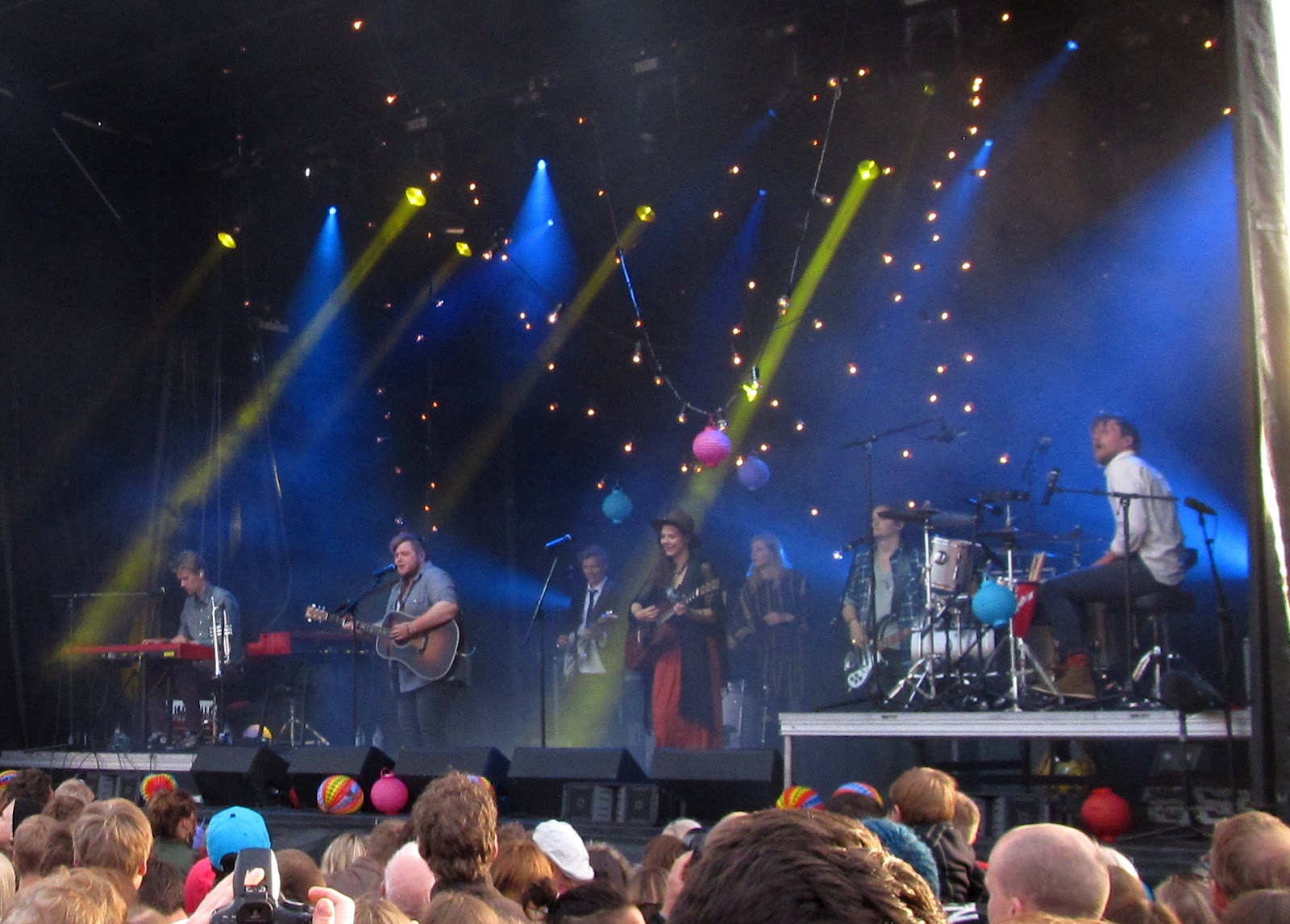
And I do adore this place. There have been a lot of wonderful moments recently. Two Saturdays ago I spent an evening an evening in the midst of a crowd of Icelanders watching a free outdoor Of Monsters and Men concert. (Following in Sigur Ros footsteps, they decided to do this show right after getting back to Iceland from an American/European tour). There was 10pm sunshine and a sea of blond hair and such wonderful, happy music. 

 
 Icelandic baby, ready to rock.
 I really adore these guys.
  
They played "Sloom" for the encore (see my video above). The whole scene may or may not have made me cry. 

                This past weekend, Morag and I took a trip to Videy Island (about a five-minute ferry ride from Reykjavik). We walked on the paths and had an incredible lunch and visited Yoko Ono’s Imagine Peace Tower which is lit up every winter. 


 Morag
 
 Perfection
  
                 Thanks to the help of some new Icelandic-American friends, I’ve also been able to meet quite a few people for interviews. I’ve had a lot of conversations lately with people who are (relative) newcomers to Iceland.  Though the focus is on names, I can’t help but feel that these talks of place and identity are almost too directly tied to my year and its unfolding right now. These conversations become more meaningful as I try to make sense of it all; figuring out my own place in Reykjavik and reflecting on my other homes throughout this year in the strange time of living at the end.   


    Yesterday I met with Maria, a Columbian woman who has lived in Iceland for twenty-two years. She talked to me about how much the city has changed since her arrival in terms of the number of foreigners and the opportunities for them. We talked about the organization she started for newcomer families, her three teenage children who are fluent in Icelandic and Spanish, her parents and sister who came to Iceland from Columbia to join her here two years ago. We ate her delicious pumpkin-sweet potato soup in the garden behind her apartment, sopping up leftovers with thick rye bread on the brightest and warmest afternoon I've had since I arrived. 
                 I asked her how her parents liked Iceland, and how it was for them to move here from Columbia. She told me that parts were hard, but she added, “All you can do is take some parts of home with you. No place will ever be the same as any other place.  But my parents made the decision they were going to be happy here, and they are.”
    As if the true meaning of heima was a kind of happiness.  
    I think she might be right. 


                 I have, inevitably, entered the process of homecoming. It’s a bit impossible not to, though as it approaches it also feels oddly anticlimactic. The only ceremony I will have will be the packing of my big blue bag. Laundry. Getting my tax refund. Cleaning out the fridge.  Tasks turned into rituals so mundane they are almost anti-ceremonies.  The planes I take on July 27th will be full of people making their own journeys, who have no idea that I’ve been waiting for this moment for the last twelve months. Unlike many other markers of time in my life up to this point, this is an ending that will not be visibly marked.  
Maybe it is this feeling of anticlimax that I'm fighting against by investing everything with meaning. Heima.  The yogurt expiration date. Music.  Getting teary taking photos of colorful Reykjavik houses before it’s too late. I’ve been here long enough now to see the lupines dry out, soft pods of seeds replacing their purple and blue blossoms. The sun has begun to set around midnight.
 I’m trying to soak it all up though my brain can’t really think of anything else besides what will happen in ten days. I’m still going through the motions, taking long walks through the city (really a small town in disguise) on white nights (really afternoons in disguise). I’m still setting up interviews and meeting friends of friends and talking to people about how we’ve all found ourselves in this place, how we’ve all found a home.  
I’m reading too much into the word “heima”. Trying to disentangle and then rejoin those phrases, “at home” and “homeland” in a linguistic kind of dance. If nothing else, I want to remember that I found ways to be at home here, even when I wasn’t. I want to remember that even in this strange time, there was the decision to be happy—to hear music at outdoor concerts and take a boat ride to an island and eat Icelandic pastries at cafes. Thankful to be at home, excited for a homecoming. 


Friday, July 13, 2012

Countdown Continued

Everything feels like a sign pointing to home these days--from the restaurant downtown playing Simon & Garfunkel's "America", to the fact that the yogurt in my fridge has the expiration date of July 27th.


It might not be a cosmic sign as much as it is a pro-biotic warning that I probably shouldn't eat yogurt for breakfast before my flight, but guys, it's been a year (almost). A year.  

351 down, 14 to go.

Tuesday, July 10, 2012

Name Post: Laws & Loopholes


             It’s one thing to read the laws that regulate names in a particular place, and it’s another to get a glimpse into the actual process of how they affect the decisions people are making. What I find kind of amazing about the system in Iceland is how watertight it is. Unlike in Germany, where it seemed like names were being added or made exceptions for all the time (something that makes sense considering the German population is much larger and less homogeneous), Iceland has a remarkably straightforward (and strict) system.  I’ve been lucky to get some insight into the process of name approval in Iceland from a variety of perspectives over the last couple of weeks.  
Sola, who I talked about in my last name post, gave me a glimpse into what getting a name approved looked like from a parent’s perspective. She has two children, Jón Þór, (pronounced like “Yown-Thur”--a combination of his two grandfathers’ names), and Súsan Klara. She wanted to name her daughter “Susan”, after her American grandmother, but in Icelandic, without the accent over the “u”, the name would sound more like “Suh-san” than “Soo-san” She thought that adding an accent to the “u” would make it look more Icelandic, but sound more like the American version after her grandmother.
She told me that, somewhat ironically, the name “Susan” is approved in Iceland, but for “Súsan”, they had to write to the committee to ask for permission. It was a fairly straightforward process where they went down to the government registry bureau, paid 3000 krona (around $25) and wrote a paragraph on a form about why they believed “Súsan” would fit with the Icelandic language and grammatical rules. A few weeks later, they checked the Committee’s website and learned that “Súsan” had indeed been approved. (They also got an official certificate in the mail—one that they plan to frame for Susie when she’s older).
Because Súsan followed all components of the name laws and “an” is a common ending to conjugate for girls’ names here, it was pretty clear the name would go through. The process isn’t always this simple. I recently had the chance to talk to Guðrún Kvaran, the author of “Nöfn Íslendinga” (in English: “The Names of Icelanders”), who works at the Institute for Icelandic Cultural Studies.  The first edition of the book came out in 1991 and to write it,  Guðrún compiled the names of all the Icelanders who ever lived. (I’m not joking. This sounds like an impossible task, but as she pointed out to me, “There haven’t been that many.”). She started with the first-ever census in 1703 and kept going from there (note that she only used names with evidence showing people actually used them…for example, she didn’t use all of the names from the Sagas, since it’s unclear if the people in them actually existed for not).
 Guðrún was the perfect person to write the book, (the first of its kind in Iceland), because she was also the Chairperson of the Naming Committee for several years. She told me a few things I found especially interesting. First of all, just because a name has been used by Icelanders in the past does not mean that it is automatically approved today. There are some names in her book, for example, that she indicates would need to get approval from the naming committee because they might not fit to today’s standards.
She also told me that in practice the law that parents can’t give their children names that would be embarrassing to them rarely has an effect on the ruling of the committee. In recent memory, there have only been two names that were rejected for this reason alone: Satania and Lucifer.  She also told me that while this law is applicable for parents naming their children, if an adult comes to register a name change, they can’t reject his or her choice on these grounds. The example she used was “Cactus.” “If an adult wants to change his name to Cactus,” she told me, “we can’t say ‘no, you can’t do that. That would be embarrassing for you.’” Because of this, the committee would approve the name Cactus, but, once approved, this means others are allowed to use it as well. If an adult Icelander has changed his name to “Cactus”, hypothetically, parents could now use it for their children. “We just have to hope young parents don’t hear about this particular name,” she told me. 

She also explained that on the inside, being the Chairperson of the Naming Committee in Iceland is a very stressful job. The committee has a traditionally rocky relationship with the public, who generally seems to feel they make their decisions according to personal opinions and biases rather than the law.  She told me that when she was the Chairperson, her weekends would often be dominated by intense conversations surrounding these issues.
            In Iceland, parents are not required to give their child a name while still at the hospital. In fact, today most parents don’t even reveal the baby’s name to anyone until the baptism a few months later (today 60-70% of Icelanders are baptized).  Most people decide on a date for the baptism, and discuss what the baby’s name will be with the Priest so he can plan a fitting ceremony. Guðrún told me that this often resulted in many panicked phone calls on Saturday nights before Sunday morning baptisms.  Pastors would often call her at home, asking if she thought a particular name would go through or if he should encourage the family to choose something else.  She said she would receive these phone calls and would always picture the cakes these parents had already baked, the family members they had already invited, and sigh.
            I got to hear the other side of this from Pastor Sigurður Árni Þórðarson at Neskirkja, downtown last week. He told me that he tries to emphasize to parents that he is baptizing the baby, not the name, so if the name doesn’t go through, it doesn’t somehow render the baptism invalid.  It’s an interesting distinction though, and he told me that very few parents would want to baptize their child with a different name than the one he or she would end up having. He told me that he’s learned to ask the parents’ if they’ve already gotten approval for a name before the baptism, and if he’s skeptical, he’ll check the committee archives online, or ask the parents to show him a form from the registry as proof. He told me a few times parents believed they could “sneak in” a name if he baptized the baby with it, even if they hadn’t gotten permission first.
            Apparently, it’s a valid concern. Guðrún told me about one case where a baby girl was baptized “Blær.”  (In Icelandic, “æ” is pronounced like “eye”).  Apparently, the priest who baptized this baby didn’t think anything of it because Blær is a relatively common name.  The family soon learned, however, that this name was not approved for girls. The battle between this particular family and the committee has been going on for the last fourteen years.  The teenage girl in question has “Stúkla” (“girl”) written on her passport.  Currently, the parents are appealing to the Minister of Justice and part of their argument is that their daughter was baptized as Blær. In Iceland, a country where there is not separation of church and state, this might carry some weight.
            Despite the possible tension these issues clearly bring up, Guðrún clearly loves her job. She talked to me about how you can learn Icelandic history just from looking at the patterns of Icelandic names. She’s studied how in the late 19th century, when the struggle for independence began, Icelanders began using names from the Sagas as an expression of their patriotism. She talked about how the Danish influence on Iceland can be seen from the adoption of middle names—a fashion that began when they arrived.  Guðrún told me that today 80% of children in Iceland have a first name and middle name, and most often first names are two syllables and middle names are one. 

Apparently David Sedaris once called Reykjavik the city of "statues of depressed people." He is pretty  accurate. 

            One of the most interesting things that came out of our conversation was one of the protocols for names of foreigners.  I learned for the first time, that a name can officially become an “Icelandic name” (from a legal standpoint) if there are fifteen people with that name living in the country. Take, for example, the name “Jane.” In Icelandic, there are no names that end in “e” because that ending can’t be conjugated in the nominative, accusative, dative and genitive.  However, if there were fifteen immigrants in Iceland who came with it as their legal name and gained citizenship, “Jane” would then become acceptable for Icelandic parents to use.
From a more philosophical standpoint, I think it’s kind of fascinating that fifteen has been determined as the magic number that allows a name to become a part of Iceland’s onomastic landscape.  I’ve been thinking a lot more lately about what it means in general when names are conjugated in a language. It’s the only place I’ve been this year where names work like this. It means that names are actually changing depending on the linguistic context—whether you’re talking to a person, or about a person.  
It’s almost as if the structure of the language takes precedent over the identity of the individual—names are expected to be shaped and structured depending on their context, and names that are unable to do this are not allowed for Icelandic children.  Though legally foreigners who gain citizenship in Iceland can keep their names now, many of these names (including my own) can’t be conjugated properly, which means, essentially, there is a different way of talking about Icelanders than there is foreigners.
I tend to think of the laws about Icelandic names as having a slightly xenophobic bias to them. I’m still not sure how I feel about them now, but I do find this tiny country pretty endearing for its rule that once fifteen people are living here with a particular name, it can pass as Icelandic.  Restrictive though the laws may seem at times, I’m realizing that perhaps in addition to preserving a specific cultural and national identity, there may be provisions like these that do allow others to fit into it and that recognize that the Icelandic population is becoming less homogenous. As more and more strangers settle in Iceland, new language is required to talk about them--the national vocabulary is slowly growing, fifteen people at a time.