Tuesday, February 21, 2012

Twenty Three

One year ago, I remember waking up with a bad cold. I was in the middle of tech week for my acting thesis and trying to figure out how to make my voice last through my six hour dress rehearsal that evening. Earlier that weekend, I had celebrated my birthday with the 4th annual Vermont party where friends came to a dirty basement to dance, eat Ben & Jerry’s and drink Magic Hat beer and Woodchuck cider. (Swarthmore is the only college I’ve heard of that will actually fund your own birthday party if you invite the whole campus). We wore paper hats with the John Deere logo on them and flannel shirts and tie dye.

Because we had celebrated over the weekend, I was surprised to enter the dining hall that Monday and find friends waiting with signs and streamers. There was an everything bagel with a candle stuck in it and bottles of champagne and orange juice. They gave me gifts of homemade artwork and books of poetry and a tambourine for our not-so-serious all girls’ acoustic cover band. I have amazing (and amazingly creative) friends. Those of us without class took a train into Philadelphia. We stopped at DiBruno Brothers for cheese and hummus and chocolate cake and went to Anthropologie to try on dresses we couldn’t afford. I was overwhelmed with gratitude and love for these inspiring people in my life; for my family wishing me well from afar, for friends to celebrate with, for the loving and close community I found on that campus.

At this time last year, I had no idea that I would receive a Watson fellowship. I had just finished my final interview days earlier, and had even tried to stop thinking about it as a possibility.

I had no idea that I’d be waking up one year later so far from that loving community and so far from those amazing people.


But here I am today, waking up in Friedrichshain, Berlin in the apartment of someone I met just over two weeks ago. There was no way to predict I would ever be here. Sometimes it all just feels so surreal.

I'm currently at Berlin Tegel airport. There's snow falling outside and my flight is delayed. Hopefully, in a few hours, I will meet my sister in Istanbul. Hopefully, we will eat good Turkish food and look at snowy streets and figure this whole thing out together. I will be twenty three.

In some ways everything has changed. I'm miles from home, whether that is Swarthmore, PA or Burlington, VT and I am very much alone. In the past year, I became a Watson Fellow, a college graduate, a sister-in-law.

But I am still overwhelmed with gratitude and love for these inspiring people in my life; for my family wishing me well from afar, for friends to celebrate with, for the loving and close communities I have found.

I like twenty-three. I like that it's an odd number and I like that it puts me more solidly “in my twenties.”

If I look forward one year, I have no idea where I'll be, but I'm starting to be more okay with that.

Thank you all for the love. I am one lucky girl.

I'm also sending love today to my birthday twin and grandfather today. This photo was taken many February 21sts ago during one of our many breakfast in bed traditions. Happy 88th birthday today, Papa, and happy 60th wedding anniversary to you and Grandma.


Monday, February 20, 2012

Name Post: Babies of Berlin

Berliner dome.

I spent a couple days last week inadvertently learning more German children’s songs and farm animal sounds. I tagged along with one of my Berlin contacts, Michaela, and her fifteen month-old, Anna, as they went to two different parent/child groups. In between songs and time on the jungle gym, I talked to some parents about their children’s names and the stories behind them. Despite the strange looks I usually get for being a childless young person in a room of these parent/child duos (looks that don’t usually stop when I explain that I’m studying something as seemingly random as names), I really enjoy these interviews with parents. I’ve found that, in general, parents are the people who are just as engrossed in the name world as I am, and because most often they’ve spent nine months (or longer) thinking about these things, I learn a lot from conversations with them.

My notes are a little scattered. I got more information from some parents than others (this was largely dependent on language barriers as well as the mood of their child at the time they were talking to me!), but here are some of the names of these Berlin babies and their parents' motivations in choosing them:

Josephine Annie Alice, sister to Lillamore

Josephine’s mother explained that these names were chosen for her daughters because she and her husband wanted names that worked in three places: she’s British, her husband’s French, and they’re all living in Germany. She told me Lillamore is typically a Scandinavian name and they tried to give their daughters middle names that reflected their family background on both sides (for example, Josephine’s second name, Annie, she thought of as an English name, and her third name, Alice, is pronounced the French way).

Philemon Ruben Gabriel, brother to Seraphina Maria Antonia and Cherubin Francis Raphael

These names are quite uncommon for Germany and Philemon’s mother explained that she chose them because they’re all names of angels in the Bible. She told me (perhaps because of the commonality of the middle names they chose), she didn’t have trouble getting them approved at the standesamt. She deliberately gave the kids more common middle names in case they didn’t like their (more unusual) first names.

Tara Maya, sister to Leyla Mara and Dilara Zahra

Tara’s mother explained that because her husband is originally from Turkey, it was a priority for them to choose names that would work there or in Germany. She told me that every time she was pregnant she would watch movies and read through all the screen credits for name suggestions.

Charlotta Alexia

Charlotta’s parents decided on the Italian version of Charlotte to make it a little more unusual in Germany. “Alexia” is taken from her mother’s late sister’s name, Alexa, in remembrance of her.

Elisabeth Charlotta, called, Lilo

Lilo’s mother explained that the Charlotta part of her daughter’s name was chosen because she was born in the neighborhood of Charlottenburg in Berlin. Elisabeth is the name of her grandmother and sister, and she liked that in putting the names together, she could form the unusual nickname, Lilo, which also works on its own.

Lennart

This mother explained that “Lennart” is a Scandinavian version of Leonard that she chose partially because she loved the nickname “Leni.”

Timon

Timon’s mother explained that Timon is a Greek name that’s also pretty common in Germany. She liked that it means “honorable” and that it’s a name her relatives in Poland can pronounce. She’s currently pregnant and she and her husband are having a really hard time deciding on a name; she says it’s hard to find one that goes with “Timon.”

Anna Sophie

Anna was chosen because her parents liked that it was classic name but not too popular. They liked the soft sounds that Anna Sophie has together, and that they felt the name “Anna” would work on her at any age.

Giorgius

Giorgius was named after his grandfather, according to Greek tradition. His mother explained to me that in Greece, typically first borns are all named after the grandfather or grandmother (she told me this is why the scene in My Big Fat Greek Wedding where all of the cousins are introduced as “Nick” or “Nicolette” is scarily accurate). We also talked about how in Greece, names change whether you’re talking to the person, or about the person. “Giorgius” is actually “Giorgu” when he’s being spoken to.

Nollaig Gustav, brother to Ava Sinead and Jack Joseph

Nollaig’s mother explained that her husband is Irish and they wanted to continue the Irish tradition of naming your children after a family member. Her husband’s uncle and brother are both named “Noll" and “Nollaig” is from that. She liked old fashioned names and wanted names for all three kids that would work in Ireland and in Germany. We talked a lot about when names cross cultures in these places, and she told the group about how her husband liked the name Kevin because he saw it as a not too popular, classic Irish boys’ name. She told “absolutely not” and had to explain what “Kevin” has come to be associated with in Germany.

Luc

Luc’s mom explained that she saw this name in the Bible and loved how it sounded.

Alexander, brother to Anegrit

Anegrit is an old fashioned name that was big in Germany in the 1950s and 60s. Annagritte’s mother wanted the name “Anna” but her husband wanted the name “Gritte” and she said this was a compromise. She said the decision was harder when it came time to name Alexander, because, as she joked, with boys you can’t use the names of ex-boyfriends. They eventually decided on Alexander because they wanted a name they felt wasn’t too popular, but was a classic.

After talking to these groups of parents, what was amazing to me was just how much they were on the same page. As you can see from above, almost every parent wanted their child to have a name that wasn’t too popular, but a name that could also be considered “a classic”. In many families there was also the question of representing both sides of the family in terms of cultural heritage.

What was also interesting to me, however, was how every single parent (actually, they all were mothers), was in support of the German naming law. As one mother put it, “I like to think I’m open minded, but then I hear some of the names that are chosen and I think, they were allowed to do that? The poor kid.”

I completely understand where they’re coming from, but I also think it is somewhat ironic that (almost) all of these parents wanted unusual names, but all of them were also simultaneously in support of there being a restriction on the names that can be chosen.
I find the part of the German naming law about the welfare of the child to be the most interesting. Six weeks later, I'm still really torn about where I stand on this. Yes, I think it’s absolutely horrible that a couple in the U.S. would choose to name their child Adolf Hitler, for example, but I’m also not sure where I stand when it comes to the question of if I would take away their right to. And, to be honest, I kind of feel like if a child has parents who deliberately choose to name him Adolf Hitler, that kid is going to have a lot bigger problems than what his name is. I also think it is kind of impossible to create a law that restricts names without it leading so some kind of ethnic and cultural biases (I would argue this is what has happened in Morocco, for example).

But when you look around a room of children, like I did last week, and parents calling them by their names, it’s a reminder that these names are people. And while my American liberal biases tend to show through in my belief that people should indeed have the right to name their kid whatever they want, when you’re in a room full of babies, it’s a reminder that names are representing something much bigger than linguistic origins, cultural heritage or popularity trends. Sometimes, I think in all this research, that part is easy to forget.

I was talking to Nollaig’s mother about my travels and when I mentioned that I left last July, she told me that July was the month that Nollaig was born. I looked down at him, in her arms, and I was a little speechless. It was kind of amazing to see this journey that I’ve been on reflected in this little person. While I was in Indonesia and India and Morocco and Germany and Denmark, he came into the world. He cried and learned to roll over and sit up and had an equally busy last six and a half months. It is amazing to me how much can happen in that time. It's a reminder that as I study names, and talk to professors and institutes, parents and children, these names (and the people who carry them), keep coming into the world, living and breathing their own definitions.

Friday, February 17, 2012

February Spring

Three nights ago I broke my camera. I wish there was a better story to it, but the truth is I just dropped it on the floor. Hard. Specifically, I dropped it on the floor while I was trying to take a picture of the salted brownies I had just made. This felt quite important in the moment, mainly because I was going to show it to my friend Isa to demonstrate that I had successfully completed our favorite recipe even without measuring cups. I got the picture, I lost my camera.

It was a newish camera that I had bought for this year. I spent the next day unable to forgive myself and going to major electronic shops in Berlin trying to find someone who would fix it for a reasonable price, and finish fixing it before I left for Istanbul on Tuesday. As you can imagine, I was not successful. I soon realized that it would be about the same price and much more convenient to get a new one. But in a year where I write down every cent that I spend (literally), ruining a camera due to my own stupidity feels like a big loss.

But then I thought about my photos. I thought about how some people think that if you're always carrying a camera around to take pictures, in some ways, you're missing out on the moment.

The thing is, I think carrying around a camera this year has also helped me to be in the moment. Some of this year is spent talking about names and some of it is spent writing, and some of it is spent eating new food and some of it is spent packing and unpacking, but most of it is spent just looking. There have been so many times this year when all I want to do is turn to someone, and look at them, and know that they too are thinking, "Can you believe what we're seeing right now? Can you believe we're HERE?"

There's no person to turn to, and sometimes that feels really strange. But what I can do, is take a picture and know that I'll have at least have it for myself.

I went to "Media Markt" at Alexanderplatz and I paid the euros. I bought the exact same camera that I had paid for six and a half months earlier. I grimaced, I bit my nails, I wrote down the exact amount in my notebook.

And then I went outside and it was like Berlin had exploded in color.

It was the first day with blue skies in over a week. The temperature had risen and it seemed that the whole city had suddenly run outside. I ripped open the box with my new camera in it and started taking pictures.

"Can you believe what we're seeing right now? Can you believe we're HERE?"

I was there, and I saw it. I was there the February day that Berlin temporarily exploded into spring and I can show you what it looked like.

It looked like this:

The city bloomed into outdoor markets, and people came outside.

A man dressed like a musketeer sold bunches of lavender.

Someone made juice from the inside of an orange.

There were piles of hats for sale on a little brown cart.


There was a lot of graffiti, and menus on chalkboards, and umbrellas in different colors.

People drank beer outside and their hands weren't cold.

There were rivers made of melting ice and birds flying overhead.

There was a woman playing an accordion with a big orange bag.

And a man playing a saxophone with a yellow bicycle that listened.

There were old fashioned red trains in front of tall silver buildings.

There was bright sun on cobblestone streets.

When the sun went down, I decided to go look at some art.

The National gallery.
"Dreaming"

And then some other kinds of art.

I waited in line and got a ticket to the world premiere of Stephen Elliott's debut film, Cherry, at the Berlinale film festival. The highlights included getting to walk down a red carpet and listen to the cast and crew talk onstage. The down side was that the film itself wasn't very good (if you're curious about the film, I agree with this reviewer, pretty much verbatim: http://blogs.indiewire.com/theplaylist/berlinale-2012-review-however-hard-it-tries-cherry-fails-to-convince-us-that-a-career-in-porn-is-the-best-idea-ever).

Some of the cast, writers, director and producers of Cherry.


When I came out of the theater (and off of the red carpet, I might add), spring had ended.

Berlin was getting covered, once again, in thick, wet, white snowflakes.


I was glad I had my camera.

Tuesday, February 14, 2012

Name Post: Hot Off the German Press

Leipzig Street.

Current research in three parts. Bear with me.

Part I. 2011 Data

One of the advantages to meeting with the generous staff at the naming center at the University of Leipzig last month was that they provided me with the (very recently collected) data for German names in 2011. In fact, I got an officially stamped press copy and have been talking about it to anyone who will listen.

My own summary of the report follows:

Since 2006 the naming center at the University of Leipzig has been conducting research about the relationship of names to social and cultural phenomenon. They collect data about German names sing the lists from standesamts around the country. These lists are helpful for learning about given names in Germany, but it is difficult to find out from them from people are actually being called.

The most popular names for Germany in 2011 (according to these lists) are:

For Girls:
Marie, Sophie, Maria, Mia, Emma, Anna, Sophia, Johanna, Charlotte, Emilia, Leonie, Lea, Amelie, Lina, Lara, Luisa, Elisabeth, Laura, Emily, Lena, Luise, Katharina, Julia, Hannah/Hanna, Sarah, Clara, Helene, Lilly and Lisa.

For Boys:
Maximilian, Alexander, Paul, Leon, Elias, Ben, Felix, Luca, Jonas, David, Lukas/Lucas, Noah, Julian, Max, Moritz, Jakob/Jacob, Emil, Anton, Tim, Johannes, Finn/Fynn, Philipp, Louis/Luis, Simon, Benjamin, Jonathan, Samuel, Michael, and Daniel.

The names that
made the biggest rise in the ranks in 2011 were Mia (girls) and Ben (boys). In the north and east of Germany, in general, shorter names were given whereas longer names tended to be given in southern parts of Germany. Many old fashioned names rose in the charts this year, names like: Fredrich/Friedensreich, Fritz, Otto, Karl/Carl, Konrad/Conrad, Leopold, Richard, Wilhelm, Willy/Willi, Freimut and Emma, Ida, Freida/Frida, Klara/Clara, Karla/Carla and Greta.

More and more parents in Germany are choosing to give their child a second name (middle name). Also of note is that in the past year, one child was named “Adolf” for the first time in decades. Using the suffix of "son" in a first name was also a new trend this year (Richardson, Svens(s)on and Stefanson).

The following unusual names were eventually approved: Summer, Tyler, Blue, Peach(es), Apple, Phoenix, Smudo, Lennon, London, Hope, Magic, Godpower, Precious, Prince, Junior, Dakota, Sioux, Tecumseh, Cheyenne, Aragorn, Aragon, Legolas, Arwen, Tirumf, Adriatik, Topas, Wolke, Schokominza, Viktualia, Victualia, Sultan, Siebenstern, Bluna, Wasa, Laser and Klee.

The following names were rejected in the interest of the child: Rumpelstielchen, Waldmeister, Whisky, Yoghurt and Schnucki.

The longest name registered in the standesamt this year was a Nigerian surname for a baby girl: Esenosarumensemwonken.

(Report written by Gabriele Rodriguez).

Emma & Kemba in Leipzig last month.


Part II. An Interview with Jurgen Gerhards

On one of my first evenings in Berlin last week, I had the opportunity to meet with Dr. Jurgen Gerhards at the Freie Universitat Berlin. From 2004-2006 he worked on a book called "Given Names as an Indicator for Measuring Social Change" and he proved to be an excellent contact on the subject.

He told me that his interest in names first arose from a conversation at a dinner party a few decades ago. His friend was pregnant with her first child and she and her husband were having a long conversation about what name to choose.* As they mused over possibilities, it hit him that a lot of what they were talking about directly applied to a lot of the sociological theories he was teaching. One example that I loved was how he brought together Pierre Bourdieu's ideas of taste and distinction to names. In other words, he feels that part of the reason many people are searching for unusual names is (subconsciously or consciously) to distinguish themselves from others, and that these choices are actually acts of social positioning. It seems a little harsh to accuse parents who want to choose unusual names for their kids as doing so to try to set themselves apart from the masses, but isn't that, in fact, what they're trying to do?

This isn't a bad thing, and in fact one of Dr. Gerhards major points is that in choosing names, people are quite unconsciously following a whole slew of macro level social phenomenons. (In other words, exactly what I'm studying). In his book, he shows how German history can directly be traced through the names people are choosing: he shows how the era of German nationalism in the 19th century is also reflected in the traditional German names people were choosing for their children, the divide between Catholics and Protestants in the names they were choosing, how after 1945, when Germany was embedded in the western hemisphere, there was an increase in foreign sounding names, and how globalization today is reflected in an increase of foreign names as well.

Dr. Gerhards' goal was to use quantitative data to show how these micro level decisions (discussing a name at a dinner party, for example), actually directly correlate to what is going on at a macro level (nationalism, war, globalization). What he found so interesting, is that people are following trends they seem unaware of. When he and his colleague interviewed parents about why they made the choices they did, they overwhelmingly responded it was because they "liked the name." It's interesting to think that as personal as these decisions seem, they're shaped by a lot that's beyond our control, and a lot that we're unaware of.

View from my Berlin apartment.

Part III. On Beyonce.

Red letter day: Beyonce's made the blog.

Part of what Dr. Gerhards pointed out was that names are, inherently, public goods. He thinks this might be part of why people seem so desperate to make them as unique as possible.

This is also why articles like this enrage me: http://www.huffingtonpost.com/2012/02/09/blue-ivy-gets-trademarked_n_1266898.html

For those of you who don't want to click the link, this article is about how Jay-Z and Beyonce are trying to get the name of their 1 month old, Blue Ivy Carter, trademarked. Besides the uncomfortable idea that they're basically making their baby into a brand, I find it also kind of defeats the purpose of names. Think of the power that there is in sharing a name, and the number of parents who deliberately name their child after their grandmother, or favorite poet, or best friend. When someone is given a name, there is the inherent idea that there were people with that name before them, and people with that name who will come after them. They all are part of creating its definition. There is something special about this, I think, especially when you look at places like Bali, where a huge majority of the population shares the same name, or India, where names are shared among people, gods, goddesses and rivers. Perhaps this can be consolation for German parents who are reading Part I above and worrying about the number of Pauls who will be in their son's kindergarten.

I too am a fan of unusual names, and I too can't quite articulate why. I don't like to think it's a means of social positioning (a la Bourdieu), but maybe it is. Regardless, I think there's a line, and wanting to trademark your baby's name is definitely over it.

I can't help feeling a little sorry for Blue Ivy actually, who, it seems, will now share her name only with her own clothing line.

Marienkirche in the snow, earlier today.


*If you're curious, as I was, this couple eventually decided on "Stella."

Friday, February 10, 2012

Berlin Beginnings


Things are looking up. The city is covered with snow and I finally gave in and bought myself something more adequate than my Moroccan leather jacket. The news of the unusually low temperatures sweeping across Europe must have reached the United States and I knew I had to give in and buy something warmer when I got an e-mail from my grandmother begging me to.

I'll be in Zambia in under three weeks, so it seemed a bit of a waste to buy a jacket now, but with temperatures colder than they currently are in Burlington, something needed to happen, and I have a feeling I'll keep enjoying this very reduced-price teal number when back in the U.S. next year.


This Vermonter was sick of chattering teeth.

Speaking of Vermonters, things are also a little brighter in honor of my mom as she celebrates her birthday today. My mom is mentioned quite a bit on this blog, so it comes as no surprise to know that she is (by far) the person I have been in closest touch with on this journey (mainly because she'll drop everything at the sound of a gchat from one of her daughters). Through the packing meltdowns of last summer, tearful goodbyes, and frantic phone calls from airports this year, she has been my rock and I truly don't know how I could be doing this journey without her constant love and support. I am so so grateful I am out of my teenage years and can now appreciate what a wonderful mom I have. I am so very lucky.

Speaking of incredible support, I greatly appreciate all of your comments and suggestions as I try to plan my next steps. Yesterday I spent a good few hours e-mailing former Watson Fellows who had traveled in Zambia and received an overwhelming 17 responses. I am so enormously touched by this, and it is so comforting to be reminded that through this fellowship, I've also gained access to such a wonderful network of people who have done this before. I am far from alone. Although I'm still on a desperate search for inexpensive housing in Lusaka, and not much progress has been made, I'm reminded of the attitude I need to have on this journey. I've always been a planner and this year has proved to be a constant reminder to let go a little. I can always book myself a few nights in a hostel and see what comes up once I'm there.

And it's hard to be too angsty in as nice a city as Berlin.

There is art everywhere here. It peeks through the snow and covers metro stops, and is found in the most unexpected places. In some ways, it makes it difficult to be a tourist here because there is an overwhelming amount to see (this is a good problem to have).

Sculpture outside a department store in Alexanderplatz.

My favorite Berlin sculpture (thus far) outside the Marienkirche.


I like it here. In stereotypically German fashion, the public transportation system is efficient and punctual and it makes it remarkably easy to get around (even in -10 degree temperatures where you don't want to be waiting outside for too long). I also like that the city is made up of these lovely little neighborhoods each with their own character, so you can walk around and feel like you're in a little town despite the fact that you're in a big city.

View of downtown Berlin from the Alexanderplatz TV Tower.

Berlin is quintessentially cool. Berliners are not known for their friendliness (though I haven't found this to be a problem), because they have the reputation for being consistently nonchalant. That said, Berlin doesn't feel full of itself. I think it has too recent of a tumultuous history to be pretentious, and it's refreshing to be in a city that is so artistic and hip without being insanely expensive or unmanageable. I heard a story before arriving that the governor of Berlin recently said that Berlin is, definitively, a city that is "poor but sexy." In other words, it's a good place to be a traveler.

My visit is also greatly enhanced by Silke's generosity, and the fact that her apartment is absolutely beautiful.

Silke in the apartment, continuing the German "kaffee klatch" tradition of cake and coffee at 3pm.

Afternoon sunlight in my temporary bedroom.

The outdoor market we attended in our neighborhood last weekend.

I've come to Berlin at the right time. My visit happens to coincide with "Berlinale", Berlin's international film festival. With nearly 500,000 admissions it's said to be the largest publicly-attended film festival worldwide. This means that I'm joined on Berlin's snowy streets by Brad Pitt, Angelina Jolie, Jake Gyllenhaal, and (be still my heart), Meryl Streep. I decided to try to be a true Berliner by waiting in line for tickets last Monday to some of the films. It is a complicated system in which you can only buy certain tickets to certain shows on certain days. After waiting for three hours, most of what I wanted to see had already been sold out. In a desperate attempt I asked the woman at the desk if there were tickets available to the public for some of the "Berlinale Talent campus" events (these are seminars, classes, and lectures meant to be attended by 350 "up and coming" filmmakers around the world). The woman at the desk said there were a few tickets for the public as well and completely on a whim, I said, "How about the acting class with Andie MacDowell?" She typed it into the computer and then informed me that there were exactly two tickets left to the event.

At the price of eight euros, Sunday afternoon will find me in a room with Andie MacDowell, trying to absorb her acting tips while trying to act as nonchalant (and non-starstruck) as a Berliner.

Besides hoping for run-ins with the stars, trying to plan my next moves, and conducting a couple name interviews, this past week in Berlin has found me taking in the many sights and trying to stay warm in museums. There are many to choose from.

Brandenburg Gate.

Potsdamer Platz

Charlottenburg Palace

The Reichstag

Gendarmarkt (said to be the prettiest spot in Berlin, this square is home to the concert house and two French & German cathedrals).

Statue of Schiller in the center of the Gendarmarkt.

The Jewish Museum (my favorite museum thus far).

Alexanderplatz TV Tower and World Clock.

And then there's "currywurst." There's a lot of dispute among Berliners about what the best place to get currywurst is, but the verdict is, it's all good. (Note: it is much more appetizing than it looks).


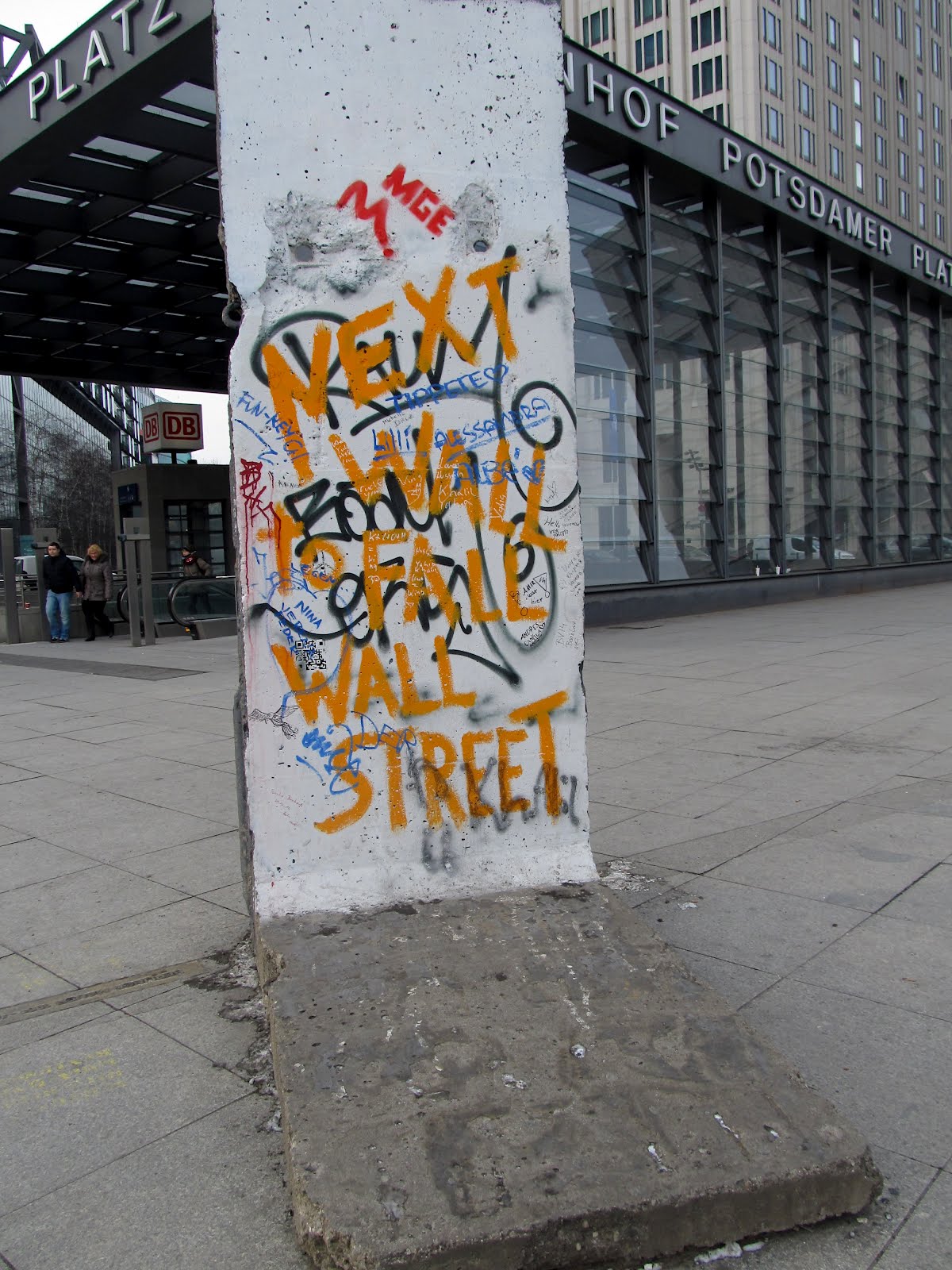
I also really like this "wall concept" that I ran into on Potsdamer Platz. The Berlin senate in 2005 decided to scatter the remaining pieces of the wall around the city as a way of raising their profile and acting as a memorial for the victims of the wall.


It is impossible not to think about the wall a great deal with living in Berlin. Because, unlike many other people living in the world today, it isn't a part of my living memory (I was born the year the wall fell), I don't think I appreciated how much it impacted people worldwide. Berlin seems to still have an unsettled relationship with this recent history; on the one hand, there are tourist sites devoted to the checkpoints and offering bits of the wall for sale. On the other hand, you are constantly reminded that these are actually, to quote a city bus brochure, "sites of terror."


I think the massiveness of it all really hit me when in the "Checkpoint Charlie" museum. There was a small plaque dedicated to a five year-old that had died in the river. No one had dived in to save him because the river itself was divided between East and West Germany and people were scared if they swam in the wrong part of it, they would be shot by East German border guards.

Most boundaries are invisible. In one of my college seminars we talked about this a lot and we talked about a character in Amitav Ghosh's beautiful novel, The Shadow Lines, who takes her first flight and cannot believe she can't see the border between India and Pakistan, despite all of the controversy surrounding this border.

The Berlin wall is and was so visible. I think Berliners are still (understandably) trying to figure out what to do with it and what to make of it (literally and figuratively).

For now, in typical Berlin fashion, it's become art. The "Eastside Gallery" is the only remaining strip of the wall that's left where it originally stood and on it artists have made their own murals.

Eastside Gallery.

"Next Wall To Fall: Wall Street."

It's a good answer, I think.