Wednesday, November 16, 2011

Of All the Gin Joints

Admittedly, I was only in Casablanca for about an hour and the number of movie references I've been making is pretty disproportionate to that.

Now that that's taken care of, hello again world! I'm in North Africa! Can you believe it? (I can't really).

Due to Monday’s airshow in Dubai (?) my plane got in late from Delhi on Monday and Emirates informed me that even though I could make the flight to Casblanca, my bag wouldn’t be able to be transferred in time, and there are apparently security regulations about people arriving ahead of their bags. Long story short, they told me I would have to wait a day before getting on the next flight to Casablanca. I was near tears about this until I arrived at the hotel they were putting me up in, saw how comfortable and clean my room was (reminder: I've had weeks of budget hotels and squat toilets in India) and saw the copious amounts of hummus and green olives and baklava at the buffet lines. I forgave Emirates for everything pretty quickly.

After a day of food and sleep in a hotel I would not otherwise have been able to afford, I finally flew from Dubai to Casablanca on Tuesday. I then took two trains to get to Rabat. My (quite rusty) French was already put into effect when an elderly drunk Moroccan man was eager to be friends on the train. We were also sitting near a young woman who goes to a British University in Rabat, so between her English and French, my minimal French, and this man’s French and Arabic, we had a lovely cross-cultural triangulation in which she would translate his sentences, mainly, “What color hair does your mother have? And your father?” and “You should act in the cinema.” He informed me that I was beautiful, but not as beautiful as Elizabeth Taylor. (Still getting over that blow to my ego). I also discovered that my French sounds a lot like garbled Indonesian these days.

Due to the generosity of an amazing friend and Swarthmore alum who had a Fulbright in Morocco, I've already been in touch with a small community of ex-pats and Moroccans living here. A few frantic housing e-mails later, I came in touch with Rachel, a fantastic American woman who organizes study abroad programs here. In an extreme stroke of luck, she was looking for a subletter and I was looking for a place. She’s been living in Rabat for three years, so she’s a great person to show me the ropes.

Best of all, because I’m subletting, it means I’m staying in the same place for the next six weeks (at least). I am basking in constant wi fi and hot water and the ability to cook for myself after a few weeks of gallivanting across India (and, let's be honest, "gallivanting across India" usually meant trying not to be run over or trampled or lost).

I’m living in L’Ocean, a residential area in Rabat which is, you guessed it, right on the ocean. This is the view from the balcony of our apartment.

On one side….

And the other…

(Yep, that's the ocean).

I feel very very very lucky.

I’m surprised by how much of Rabat actually reminds me of India, just minus a lot of people. (When I got off the train in Rabat and didn’t see tons of crowds, I actually thought something was wrong).

I've been here 24 hours now and spent the day getting oriented, wandering around and relishing in small comforts….

—like how great it feels to have a path to walk on right by the ocean. (It’s also a great spot for running, something my body will both love and hate me for since it’s been four months since that’s been a possibility…)

--and wandering around the marketplace in the old medina.

--and walking around town with a tote bag stocking up on groceries—stopping at one food stall for olives, another for vegetables, another for milk and yogurt and cheese, another for nuts and dates.

--and the fact that I can unpack and and have some sense of permanence (even a fleeting one), and basically, make myself a home.

I never realized how much of a nester I was until the sight of my clothes in drawers this morning actually made me smile.

Saturday, November 12, 2011

Namaste, India

It’s hard for me to believe that in less than three days I’ll be back to square one, starting over in a whole new country with its own languages and codes and traditions and discoveries. The last few weeks in India have gone so quickly and it feels like it wasn’t long ago I was just transitioning into life here.

Maybe this is because transitioning into life in India is anything but simple. I’ve run into many other foreigners during my time in India, and the most common answer I’ve found to, “So how do you like India?” is, “It’s crazy.”

And it is. I would not describe my time here as easy. I’m not sure how I’ll look back on my time in India in the context of this year—in many ways it feels much more complicated than the time I spent in Indonesia. I was almost constantly on the move here which at times made it hard to feel productive in terms of my research. I was on my own much more, catching trains and finding hotels and waiting in lines at monuments; forced to be my own navigator, my own sounding board, my own friend. I think my time in India has accounted for two of the most important months of my life. I’ve had to stand up for myself in ways that I haven’t had to before and I’ve realized that that’s something I can do. I’ve been exhaustedly on edge, perpetually bitter at the attention I receive because of my appearance and gender, and saddened by the staggering amount of desperation and poverty. It is overwhelming. But I’ve also been overwhelmed by the generosity of others, by the beauty of my surroundings, by how much, despite all of these difficulties, I’ve fallen in love with this place.

As Dan and I agreed in Delhi, Swarthmore seminars would not be able to survive in India because they’d want to stop and “unpack” everything they saw every couple feet. That’s how I feel too. Sights and signs run through my brain and I can’t stop thinking about them. Like a thirteen year-old Indian girl I saw wearing a t-shirt that read, only, “She has long hair and blue eyes. She is WESTERN.” (I thought the idea that she was advertising a definition of what “western” is, particularly a definition that she herself didn’t fit into was really fascinating).

Or this sign in Bangalore advertising a shop called “Feminist” that sells lingerie exclusively.

India takes all of those binaries that we’re taught to avoid thinking in, “east and west,” “developed and developing”, “traditional and modern”, and broadcasts them. There are signs in shopping malls with arrows pointing to “ethnic” clothing and arrows pointing to “western” clothing. And then there are advertisements for salwar kameezs worn by blonde models. There are people here who measure progress by the quality of the roads; there are people here who measure progress by how much dal they can convince their grandson to eat for lunch. When I visualize India, what comes to mind is a representation of the goddess Kali, with all of her many arms. If India were Kali, it would always be reaching for something. In one hand would be an oil lamp for prayers, in another an ipad, in another a dosa, in another a pair of blue jeans, a handful of flowers, a yoga mat, a slice of pizza, a cricket bat.

I’ve realized that in India, these binaries aren’t binaries. They’re all a part of it, and the “contradictions” that I’ve so enjoyed (sights of cows roaming outside of Pizza huts, or women in sarees riding motorcycles), aren’t contradictions at all. They are what make this place whole.

Perhaps because of this, recently I’ve had the strong desire bring everyone I know here. I think it’s an important place to visit. It holds 1/6th of the entire world population, and sometimes I feel that walking down an Indian street, you see everything that makes up the world.

The part that was challenging at times was figuring out exactly how I fit into this world. Or how others perceived my own role in it. But I’m realizing these are constant questions we should be asking ourselves anyway, being here just made them unavoidable. I had my eyes wide open and tried to take it all in. Its colors, its chaos, its unflinching honesty, its noise, its generosity, its lights and its traditions. I feel so lucky to have experienced this place. I feel so lucky to have met such wonderful people here who I know I will be in touch with in the future. I feel in my heart that I’ll be back one day.

Because you’re not experiencing this place with me right now, I wanted to share this little bit of India in motion. Because if there is anything that India isn’t, it’s still.


Thanks for the last seven weeks. Here we go again…

Friday, November 11, 2011

Mountains & Transitions

I’m not really sure where I got it in my head to go to Shimla. In retrospect, it’s a pretty random choice. When I met with the balian (psychic) in Ubud, one of the first things she said to me, without knowing anything about me was, “You feel at home in the mountains.” I smiled, thinking of my dear green mountains, and then she added, “I’m seeing a vision of you in the Himalayas.”

My flight to India was the following day.

Besides being a little freaked out about her seeing me in the Himalayas without me having mentioned anything about India, I had to agree she was right. I got it in my head then and there that before leaving India, I would go to the mountains.

Shimla is probably the closest mountain town to Delhi and makes for a twelve-hour train ride through the hills. The whole area basically consisted of forest until a Scottish civil servant named Charles Kennedy built a summer house here in 1822. Twenty years after that, Shimla became the official summer capital for the Raj. Every summer until 1939, the entire government of India came here to escape the heat. In 1903 the Kalka-Shimla railway was constructed and Shimla became India’s “premier hill station.” Today, the town is still a sleepy place, filled with a few prestigious boarding schools and honeymooners. It’s also become a backpackers’ haven for people trekking in the Himalayas to come stock up on toilet paper and chocolate bars.

Spending my last four days in India in Shimla was one of the best decisions I’ve ever made. I was a little apprehensive about my decision after all of the traveling around I’ve done, and the long train ride it would take, and the fact that on Sunday I’m going straight back to Delhi and then boarding a plane to Morocco that night.

But then, I got on the train. One of the charms of Shimla (I think) is the fact that you have to travel to Kalka, and then from there, take what’s called the “toy train.” It’s kind of a famous rail line because it’s tiny and goes through the Himalayas and passes through 103 tunnels. It honestly does feel like you’re riding the tracks and tunnels and hills that little kids build from wooden sets.

In an impulsive shopping decision, I bought a coat in Jaipur. Besides one fleece, I hadn’t packed anything warm for my year, figuring that it would be silly to pack something as bulky as a jacket that I wouldn’t be wearing for months. And then I saw a coat at a shop in Jaipur and fell in love, and realized that I might want it in the mountains, and, more importantly for the coming Moroccan and German winters. I bought it, and eagerly held it on my lap for the entire train ride to Shimla.

The train crept higher and higher into the mountains and other people started bundling up, because, for most Indian people, it was getting freezing. People looked on in disbelief as I opened my window wider. I stuck my head out the window like a dog, and gulped down cold, fresh air and watched the Himalayas pass by, relishing in the feeling of being, for the first time in months, cold. There was no burning trash. There was no pollution that turned everything in my nose pitch black. There was no sound of traffic. There were only the mountains. I stayed like that for two hours, and then, finally, sat back and buttoned up my new coat.

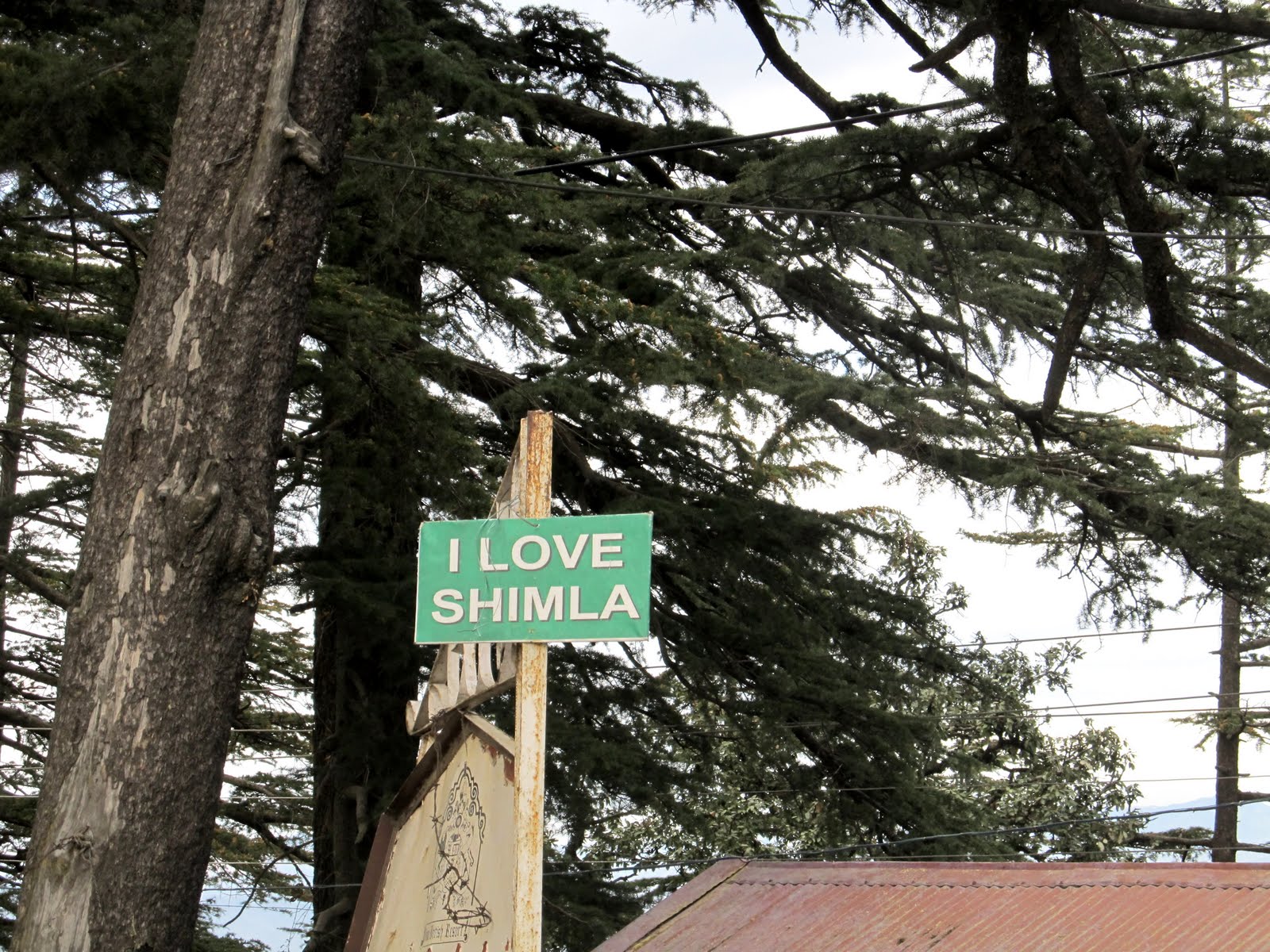
When we arrived, the first thing that hit me was the quiet. The only way to get around central Shimla is on foot. It feels entirely different from any other place I’ve been to in India. I’m staying at a place that looks like a ski lodge that you hike up an intense hill to arrive at. It has a tin roof that monkeys scamper across. It is bright and airy and reasonably priced with this amazing café that serves fresh local trout from the base of the Himalayas. They have a laundry service but told me it might take a few days for my clothes to come back because there was snow a few towns away. They have red comforters and a friendly elderly woman who manages everything, and frankly, I don’t think it could be any more adorable.

And did I mention what I get to look at while eating breakfast?

Put quite simply, I just love it here, and I love that I have this transitional time of quiet and solitude and a comfortable space to recover from a nasty cold and bed bug bites before trying to adapt to yet another new country. I’ve been wandering around the narrow pathways wearing clothes I had yet to pull out of my suitcase, and eating hot fresh French fries and tomato soup served in paper cups on the side of the road.

Downtown Shimla

I could be sightseeing or trekking, but in reality, what I really want to spend the next few days doing is this:

Minus the monkeys and Indian food, I could almost be in a small town in New England. Wandering these hills gives me the gut-wrenching feeling of being extremely homesick, while feeling, simultaneously, extremely at home.

Here’s to new coats and the weather to wear them in.

Name Post: An Inconclusive Conclusion

In the last few weeks I’ve found myself in the midst of countless marketplaces and monuments, cities of pink and pearl, painted elephants, raw silk, burning trash and dusty streets. This adventuring (and my recent blog posts) have become a whirlwind of different hotel beds and historical facts. I don’t regret taking a few weeks to just experience more of this bamboozling country, and I know that these travels are all part of this year, even though I wasn’t explicitly working on my project. But now, faced with only a few days more in India, I’m left to put together the pieces of earlier interviews and discussions, news articles, Hindu myths, and coffee dates in order to figure out what exactly I can conclude about Indian names.

My new dear friend Kamakshi (of the matching elephant nightgowns) who I stayed with in Mysore told me a story about Indian names that has stuck with me. When her son was little, she and her husband were interested in hiring someone to act as a babysitter for him and help around the house. The young woman that they hired introduced herself as “Baby.” She became close to their family, and after a few days, Kamakshi went up to her and said, “The name ‘Baby’ is all well and good, but tell me, what is your real name?” The girl shook her head and her only reply was, “Nobody cared.”

It took Kamakshi a few seconds to realize she meant that she was never named. That no one in her family had taken the time, or devoted the energy to choosing a name for her. That she had always simply been “Baby”, because that’s what she was.

When Kamakshi shared this story with me, we both had tears in our eyes. Because, if someone doesn’t have a name, doesn’t have a way of defining themselves, of capturing their identity and eccentricities and qualities in a string of syllables, doesn’t have a way of placing themselves into the world, who exactly are they, and who can they be. I can only hope that Baby somehow took ownership of her name, somehow laid claim to Baby as her identity, instead of as a noun.

I think this story is made more pronounced (and Kamakshi, thank you for sharing this story), because in India, names are gifts. The honor of bestowing a name to a child is traditionally given to a much respected older relative, like a grandfather. Kamakshi’s brother Ramesh told me that for a long time Kamakshi herself didn’t have a name because her grandfather had to wait a few months before meeting her. He wanted to see what she was like before deciding what her name should be. The Hindu naming ceremony is a rite of passage, a way for someone to begin belonging to the world. It is why I think those 285 girls with the Hindi name meaning “unwanted” were recently encouraged to choose new names for themselves; I like to think it’s a way for them to find a different way of belonging within the world.

One of Dan’s coworkers Delhi told me that it’s common for children here to ask each other the meaning of their names. It’s a common conversation to be had, and I can’t say it’s that common in the United States. Names and their meanings are important everywhere, but I think in India, like in Bali, they come to stand for much more than individuals. As I discovered through conversations with Savithri, reciting names in India summons great power. Names are a form of prayer. Names from Hindu gods and goddesses act as reminders of their stories and values and lessons and greatness. Names come to stand not only for individual people, but these individual people come to stand for the stories of gods and speak to a shared history and culture.

As I discovered through conversations with linguists, professors and sociologists, names are a political issue here. Currently there is a continuing movement to keep renaming streets and cities named after British generals back to traditional Hindi names. Perhaps less spoken about are the ways in which the caste system comes into play, and how just now people are breaking free of the idea that only certain people are entitled to give their kids certain names.

And everything is changing. Names from mythology are being replaced by names of celebrities. In the south, families are beginning to give their children surnames (which doesn’t traditionally happen there) so that filling out formal documentation in the future will be easier for them. Many families I spoke with listed practicalities like filling out the spaces of a passport application or their child’s application to a college in the U.S. as new crucial considerations to the naming process. Many Indian parents want their child’s name to be able to be able to be pronounced worldwide. And then, in stark contrast to the idea that a name could be (part of) a ticket to an international education, there are baby girls being called the Hindi equivalent of “unwanted” because their families were disappointed by their sex. There’s a new push for more official documentation, a distinction between given names and surnames, and the abandonment of the system of initials. The matriarchal system of naming in Kerala is starting to diminish. Non-Brahmins are using names traditionally used by Brahmins. Couples are starting to give their children names that are a combination of their own names. Parents are naming their children themselves rather than ask their older relatives.

I think India is going to be a dramatically different place in ten years. Or five years. Or two years. And I think these changes will not only be reflected in the food and economy and fashion but also in how people introduce themselves, what they call each other, and what is announced at their children’s naming ceremonies (if they have one). To uncover Indian names in a more thorough way, I would need to be much more focused on my research than I’ve been here, I would need to more fully understand Hindu mythology, the thousand names for each god and goddess, the local deities and traditions in each region, and I would need to be in India for years.

But I’m walking away with stories and that’s enough for me right now. I’m left thinking about names as stand-ins for myths, names as stand-ins for hierarchy, names as stand-ins for showing respect to elders, names as a way of both preserving tradition and of bringing in the new. I’m left hoping that as this country of extremes continues to change, someone like Baby can find a way of defining herself within it (that is, if she hasn’t already).


Thursday, November 10, 2011

The Pink City

If I had to judge an Indian City by its cover, Jaipur would win. Jaipur is typically the last stop on the “Golden Triangle” tour of North India (after Delhi and Agra). I was tempted to skip it, because I hadn’t heard much about it before, but I’m so glad that I didn’t. From an aesthetic perspective alone, I adored my days wandering around "the pink city” and I found it to be a welcome relief after Agra’s chaos. The whole city is kind of like an Anthropologie photo shoot waiting to happen.

And, because we all know looks aren’t everything, I should also say that Jaipur is a really interesting place. It claims to be the first “planned” city in India, meaning that it was built under Maharaja (King) Sawai Jai in 1727 and designed by an architect. Because of this, all of Jaipur is set up in a grid formation (a welcome relief from many other disorienting cities I’ve spent time in). Jaipur is the capital of Rajasthan which I found to be a pretty unique area. The state of Rajasthan feels the most like the kind of India one would envision after reading the Arabian Nights. A few miles away from Jaipur the desert begins, and even Jaipur itself is full of elephants and camels. There’s a particular style of dress worn by the people there and its famous for its textiles and crafts. (The Lonely Planet said that Jaipur is addicted to shopping and one of the best places in India to find quality things, and unfortunately for my Watson year budgeting, and fortunately for my wardrobe when I return to the U.S. in July 2012, I found this to be quite true).

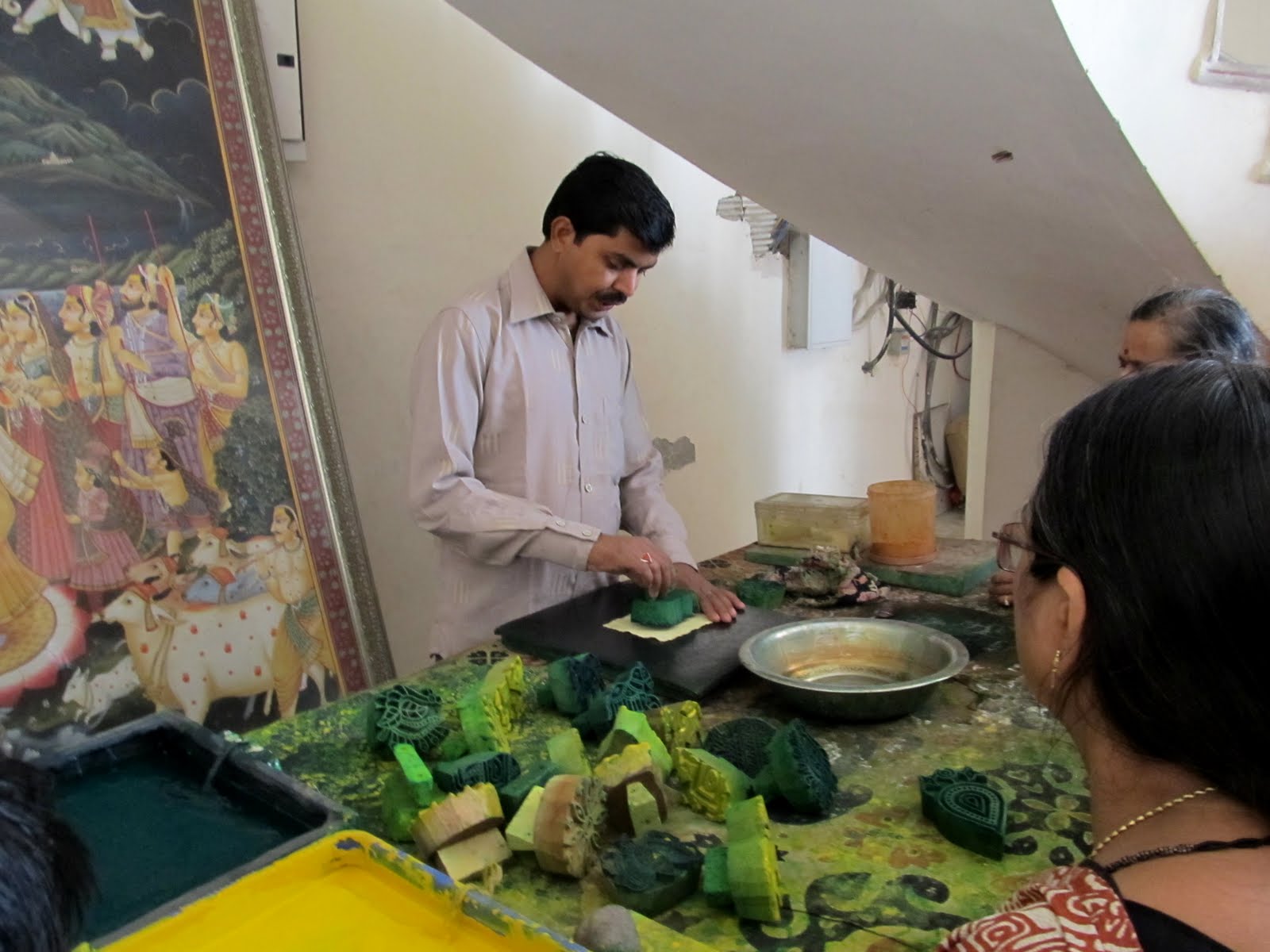
Making hand block textiles

Rajasthani Dolls

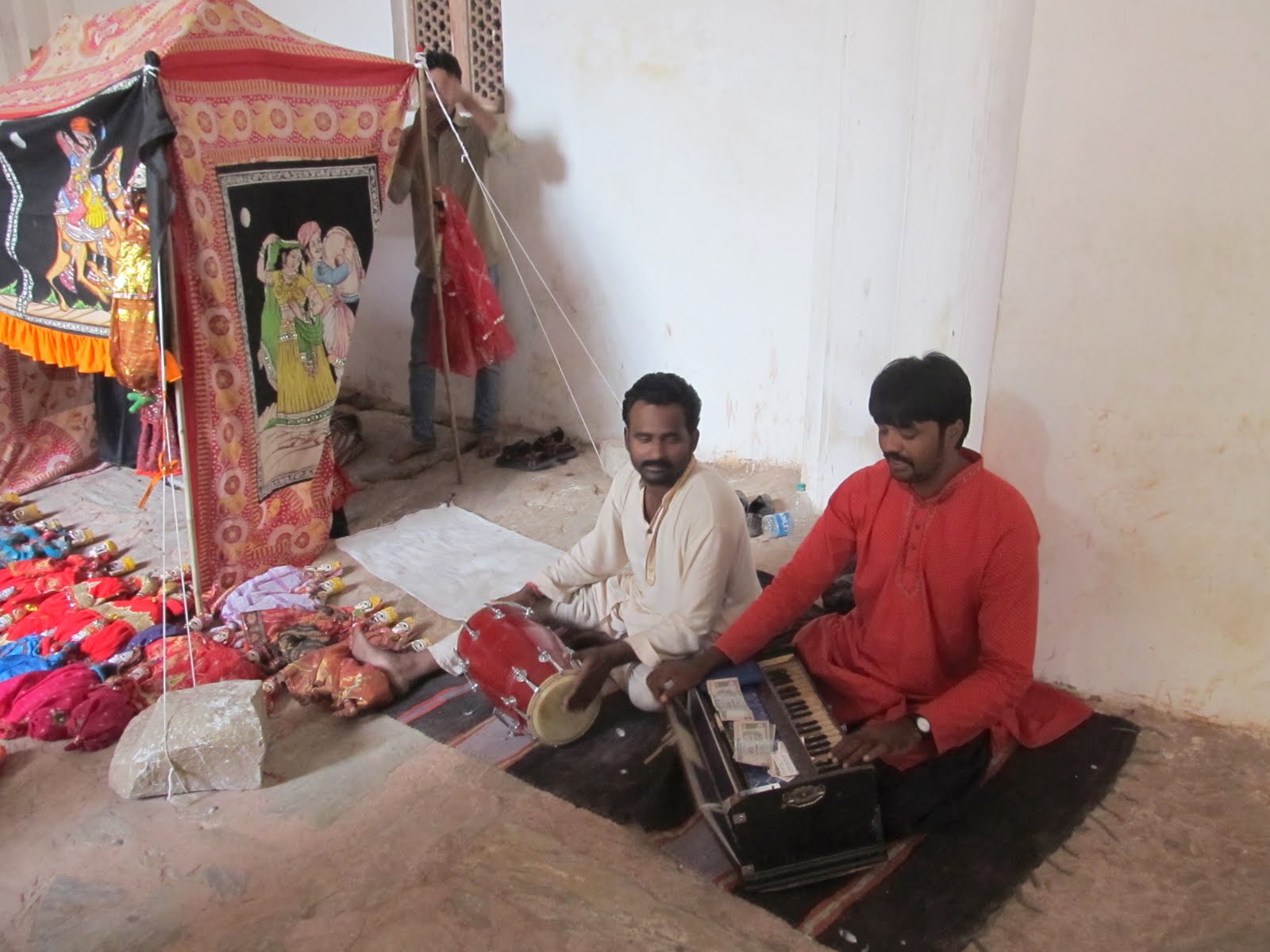
Puppet show and concert

Peacock Feathers for Sale

Another reason to love Jaipur was the student discounts. Basically every museum or historical site I’ve visited in India charges markedly different amounts for foreigners and Indian citizens (to give you an idea of how much discrepancy there can be, a ticket to the Taj Mahal for a foreigner is 750 rupees/$15 USD, and for an Indian citizen, it’s 20 rupees/$0.25 USD). Despite occasionally grumbling about this discrepancy, I actually think it’s a really good system as a way of encouraging locals to visit cultural sites. That said, I did appreciate it that every monument in Jaipur had cheaper rates for foreign and Indian students. It’s the first time in my travels I was able to flash my International Student Identity Card and reap the benefits.

Jaipur is not pink by accident. When the King was designing the city, basically, he was jealous of the red sandstone used to make many monuments in Delhi and Agra (they're pretty stunning...see earlier blog entries). Unfortunately, bringing in this kind of sandstone to Jaipur would be too expensive. The King decided he would use marble and another kind of sandstone instead, but paint it pink so it would look like the Delhi and Agra monuments. He did this specifically before the arrival of Prince Albert to Jaipur, hoping to impress him, and the “pink city” has remained pink today (at least the older parts of the city).

Because Jaipur was designed by the Maharaja, it is, quite excellently set up for him. In the center of the city is a gorgeous palace with different rooms set up for the Maharaja for different seasons. He wouldn’t walk anywhere and would just be pushed or carried around in a wheelchair, so the whole palace is made up of ramps. It’s also just gorgeous:

The Ladies Palace:

My favorite Jaipur monument, and perhaps the most iconic, is the Hawa Mahal (“Palace of winds”). This was designed for the royal ladies in the palace to be able to watch royal processions and city life without being seen. As a result, all of the windows kind of look like they’re made of honey combs.

Like Delhi, Jaipur also contains a huge observatory area (the King was a huge astrology fan and built five massive complexes all over the city).

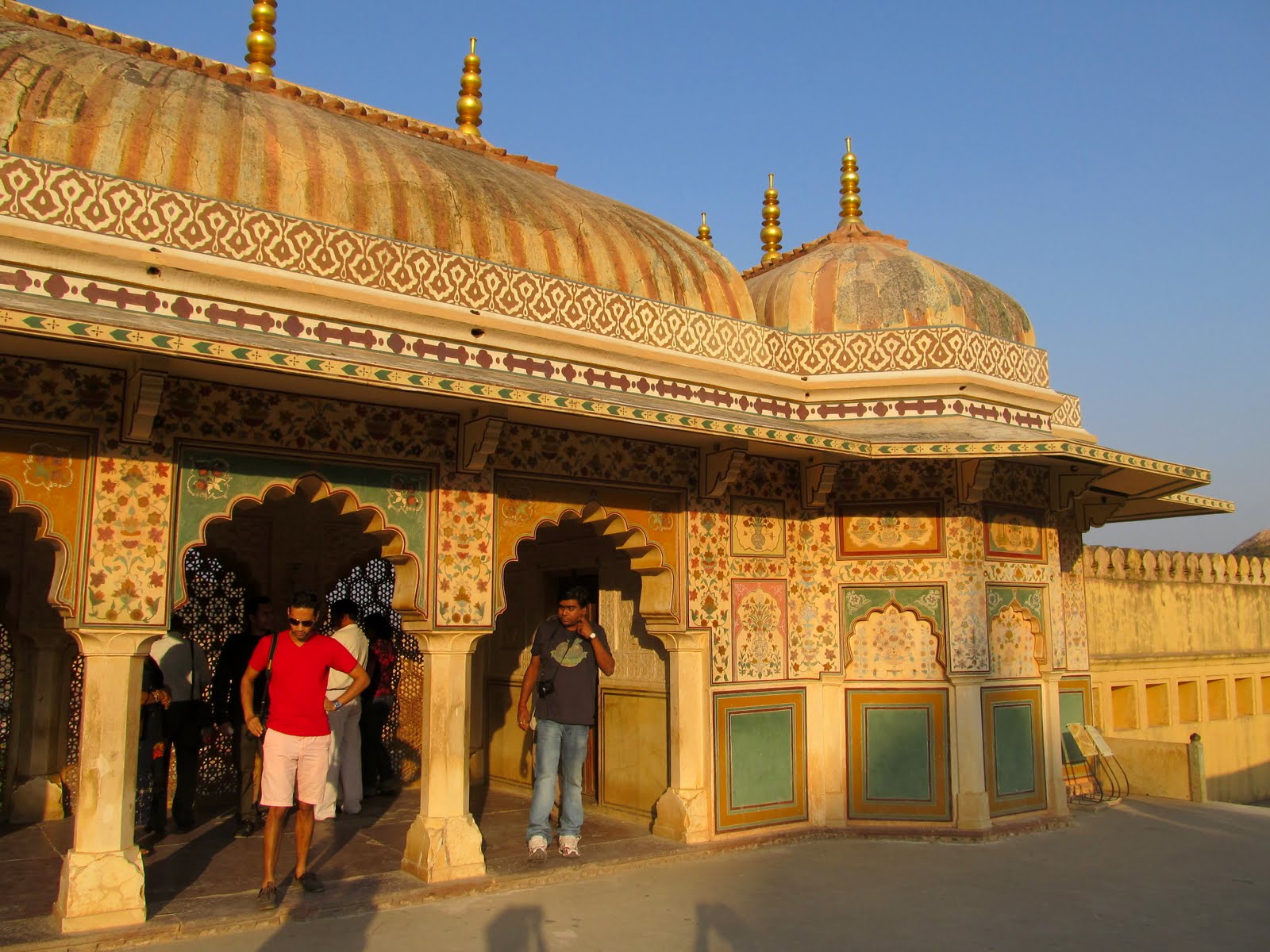
The Amber Fort. (All the forts are beginning to blur together a bit for me….I’m learning way more about defense mechanisms of the Mughals than I ever thought I would need to know…)

Amber Fort puppy

I became friends with this little girl on a tour around the city. I found her absolutely delightful, as I find all Indian children who call me “auntie” and ask for my “good name.” She also confirmed my decision that if I ever have a daughter, she will be dressed in Indian clothes exclusively.