Tuesday, January 24, 2012

Birds, Bach & Bratwurst

I’ve spent the past two weeks going to interviews with families and officials about German names in between epic bouts of hide and go seek and baking adventures at home. Several days last week, Emma & I kept ourselves (and the girls) occupied by driving into Leipzig. Leipzig is the largest closest city to my temporary German home and I’ve loved exploring the cafes and cobblestone streets.

I hadn’t heard much about Leipzig before I arrived so I was pleasantly surprised to be so close to such a great city. Leipzig is one of the two largest cities in Saxony (Dresden is the other) and has a population of about half a million. (People tell me that before German reunification there were closer to a million people living in Leipzig, but once the wall fell many people chose to move west to find work). Leipzig has a history of being a major trade city and became a large urban center for the GDR after World War II.

This monument is a Leipzig icon and was constructed in 1913 to commemorate the Battle of the Nations in 1813 which took place in Leipzig between Napoleonic France and a coalition of Prussia, Russia, Austria and Sweden. According to Wikipedia, this was the largest battle in Europe prior to World War I and ended Napoleon’s presence in Germany.

During World War II Leipzig was partially destroyed by bombings (although nowhere near as much as nearby Dresden) and then it changed quite a bit when it became a part of the GDR in 1945. Walking around the city today, the different styles of architecture you can find are pretty amazing. There are countless 1950s-style apartment buildings built when Leipzig was East Gemany next to brand new modern houses that have been renovated from bombed ruins. Wandering the streets, it is hard not to fall upon buildings with a lot of history….

St. Thomas church, for example, is the place where Johann Sebastian Bach worked as a cantor and is also home to the renowned St. Thomas boys choir. This is also where you can find Bach’s grave.

St. Nicholas church is particularly interesting because it is said to be the site where the Peaceful Revolution first began. In October 1989, “Monday demonstrations” began leaving from here and walking around the ring road of Leipzig’s old town. The protests grew bigger and bigger each week, until finally, in early December, citizens occupied the Stasi central office and branches. In the months leading up to this, when police tried to enforce a curfew to have cause to arrest the protesters, those working at St. Nicholas church invited everyone to take refuge inside. The events in Leipzig were the most prominent mass protest against the East German state.

The so-called “Old Town Hall” was built in 1556 and is currently used as a museum.

Auberbachs Keller is the bar where Goethe spent a lot of time and where a scene from Faust takes place.

I also spent an afternoon at the Rounde Ecke museum with Chris and Anne, two new friends who are students at the University of Leipzig. They showed me some other sights around the city (with a stop for the all important German tradition of “kaffeetrinken”-- 3pm coffee and cake). Rounde Ecke became the home base for the Stasi (secret police) in the GDR and today it houses a museum devoted to artifacts and documents from this time. The museum was eerie and fascinating and gave me a lot more information about what life was like in the GDR.

Perhaps the most interesting part of the museum is that it’s all preserved in authentic surroundings. As a brochure at the museum puts it, “The linoleum floor, the lattice bars on the windows, surveillance cameras and, not least, the typical GDR smell, which still lingers today in the former offices, are all reminders of the former use of the building.”

Because people weren't allowed to travel in the GDR, they hosted their own Olympics in Leipzig called the "Spartakiaefeuer." At the time, Chris's father even won a medal for his high jumping.

Kaffeetrinken at Luise cafe.

Also interesting were letters from schoolchildren that had been taken by teachers and mailed to the Stasi because they thought these students showed signs of being against the state. There were countless tools for spies, complicated letter openers, photos of the guillotine that was used from 1960-1968 and so many fake mustaches. It is one thing to read about this time in history books, and another thing to see the stacks of cassette tapes of “western music” that the Stasi had confiscated in the mail.

Because Leipzig was a trade center, it is made up of “passages” (outdoor tunnels filled with covered shops and markets). The one pictured below houses a superstitious fountain that (with the right pair of hands) can be coaxed into making music.

Chris & Anne having a go.

Hannah & Kemba in a passage.

Besides touring these monuments and churches, there have been multiple stops at cafes that stretch into hours, many many pee breaks with the girls, and stops to look at fountains in department stores. The occasionally frustrating but surprisingly pleasant thing about exploring with kids is that it forces you to slow down. I'm finding that they are helpful reminders to not only look at the buildings and remnants of history, but also at the snowflakes, the bikes, the birds waiting to be fed.


Saturday, January 21, 2012

Name Post: Discovering Kevinismus

While in Morocco, a friend who's a teacher there told me there’s an old joke that teachers are the people who have the hardest time naming their kids because by the time they’ve gotten around to having their own, there is no name left that doesn’t have some kind of negative connotation. This is one of the many reasons I really love talking to teachers about names. They’ve often seen a wide variety of names, and also get a new sample of students every year, making them the perfect people to notice how trends are changing. In the past week I’ve had the pleasure of getting to know Birgit, a kindergarten teacher whose family has lived in Wannewitz for decades. I’ve been really interested in hearing her stories about living in the GDR and I finally got to sit her down the other evening to talk to her about names.

Birgit has four kids of her own: Caroline, Tobias, Claudia and Andreas (the last two are twins). While Birgit may have avoided naming her own child after students whose names held a negative connotation, she did name her second child, Tobias, after a particularly sweet kindergartener she had in her class. Birgit has taught at a Montessori style kindergarten in the nearby town of Delitzsch for years. She talked to me about how she noticed names in this part of Germany seemed to go in five year cycles. Particularly interesting recent trends she noticed is a return to old fashioned German names like Fritz and Bruno and Sophia which has replaced the "typically East German" trend that's been going on since the 1980s where it seemed like every girl was Jessie or Mandy or Cindy.

She talked to me about names in the GDR and how until the wall came down in Wannewitz, there was no television. She thinks that this was a large reason why the names tended to be pretty unoriginal. She says there were many girls named Birgit and boys named Andreas and people didn’t tend to think very creatively about their options. She also told me about how it took a long time post war for for people to start traveling again. She said that all of a sudden, 20 years later, names like Lars and Sven are popping up in Germany, and largely reflect that people are taking holidays to the north again.

One of many old and beautiful office buildings in Leipzig.

To be clear, in Germany, kindergarten is the term used for what we in the United States would consider preschool or nursery school. The school at which Birgit teaches takes kids who are a few months old up to age six. I asked her what she thought the kids she worked with thought of their own names and if--having seen a large sample of five year-olds--names actually matter to them. She responded that almost all of the five year-olds she’s taught are very particular and very devoted to their names. She thinks that people disliking or wanting to change their names comes much later in life. She told me that often kids are very particular that their classmates speak and spell their names correctly, hanging onto those letters, perhaps because a name acts as their bridge from who they are at home to who they are in this new school setting. She also told me about the opposite affect, where a girl named “Annalina” was always just called “Lina” at home, but insisted on her full name being used at kindergarten.

This conversation got me thinking a lot of about names and identity shifts. Names often change in context; sometimes we use our full names, sometimes nicknames, sometimes name change with marriage and sometimes they change just because people need a fresh start. It’s interesting to me that these kindergarteners were already recognizing that names can change in context, and perhaps a name is a way of separating these aspects of identity for ourselves; maybe Annalina just didn’t feel like a Lina at school. My mom likes to tell the story that when I was in elementary school, teachers would always compliment her on how well behaved I was, a story that didn’t always line up with the obstinate, argumentative daughter she knew at home. She talked to me about this one day and I then explained to her that there was “Home Nell” and “School Nell.” (Clearly, “School Nell” was miraculously better at accepting authority). In other words, from a young age, I was creating my own names for myself depending on how I was behaving (or felt like behaving) in different contexts.

Hannah & Kemba are providing me with great filler photos of quintessential beautiful German kids. This was taken at a cafe while people-watching (and rolling around) in a Leipzig Starbucks.

I also asked Birgit about her own perspective on these kids’ names. I’m always curious how much our names shape who we are, and I wanted to know if there was any kind of correlation she’d noticed between kids’ personalities or characteristics and their names. She told me there does seem to be some kind of correlation because often kids with the same name come from families in similar social circles. One year she had three boys named Nicolas who were all remarkably alike. She also told me there have been a lot of studies done in Germany about teachers’ own biases against kids based on their names. She told me that there’s a running joke among teachers in Germany that any kid named “Florian” is bound to be a trouble maker. She also told me it’s been interesting to her because the kindergarten where she teaches is right next door to a kindergarten for kids who are developmentally delayed and there are certain names in that kindergarten that you never find in the one she teaches at, and vice versa.

And then we talked about Kevinismuss. Kevinismuss is a phenomenon I read about before I came to Germany, but it’s been surprising to me how many people are quite aware of it here. I’ve heard that the term was first coined in an Austrian newspaper article. It refers to the phenomenon of Austrians and Germans giving their kids names like Justin or Cindy or Jason or, the most popular, Kevin. For whatever reason, in Germany it is most often parents with less education who tend towards American names. By some strange correlation, there ended up being a lot of kids named Justin and Kevin in Germany who spent their first few years in homes that had different values or practices that might be found in most German schools. As a result, they tended to do worse than their peers once they got there. This is happening so frequently, however, that now there are a lot of questions about if German teachers have come to be biased against certain names. Some studies here have looked at teachers’ gradebooks and there’s been an overwhelming correspondence between a child’s name and how well they do in school; overwhelmingly, kids with American names in Germany do worse.

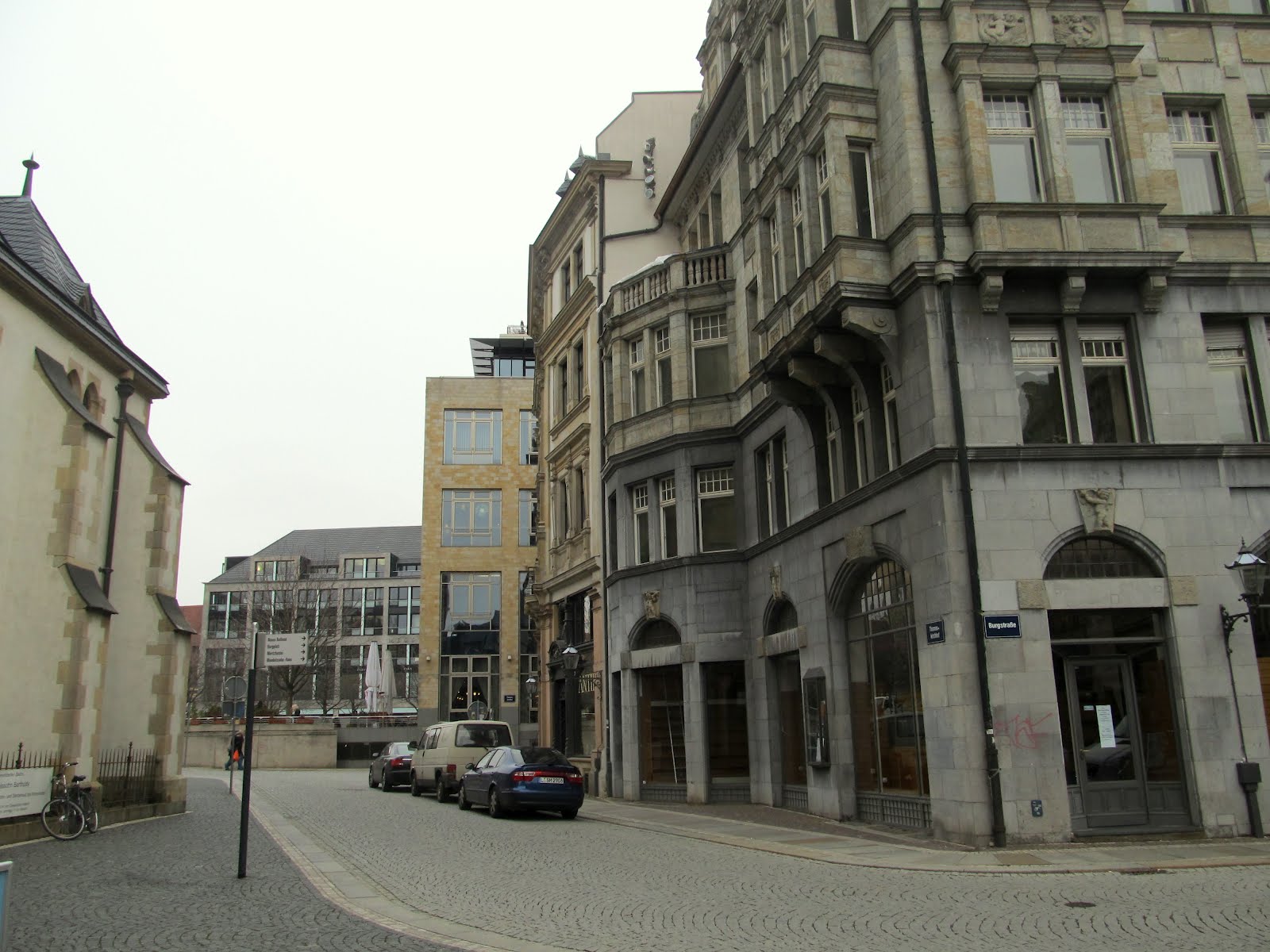
Another Leipzig street.

It was very interesting to me that there was such a strong correlation here that “Kevinismus” is a term known by many in Germany. I was trying to think if there is an American equivalent, but I think perhaps in the U.S., there are fewer names chosen exclusively by certain demographics. There have been a lot of studies about prejudices based on stereotypically “black names” and “white names” in the U.S. but fewer studies on names and the socio-economic status or education level of parents. Teachers must make certain assumptions about their students from just seeing their class lists at the beginning of each year, but perhaps few in the U.S. admit it, or maybe the trends are less overwhelming in one direction or another.

I talked to one German mom about “Kevinismus” recently. She chose to give her kids two old fashioned German names (Albert and Clara). She said that the Kevinismus trend and the laws for German names didn’t really affect her and her husband’s decision about the kid's names too much, but, as she puts it, “If a teacher is going to look at a gradebook and be more likely to give my kid better marks because his name is Albert…that can't hurt..."

Sunday, January 15, 2012

Name Post: Introduction to Germany

Let the games begin.

It feels fitting that I’m surrounded by children for my first few weeks in Germany because Germany seems deeply interested in children. I’m learning that the practices and procedures surrounding the lives of little ones are regulated on a big scale here. For one, coming from the US where children are often thought of as immense financial burdens, I was surprised to learn that in Germany every family receives a governmental stipend of 190 euros a month per child. Beyond this financial support, there are, (perhaps unsurprising if you believe stereotypes of the German government), countless rules and regulations about how children are raised. In Germany it is illegal for your child not to be in school once they turn six (homeschooling is forbidden) and there are precise details for the kind of care your child can have before then. There are kindergartens (for ages zero-six) as an option and then if those are full, families can apply to have “day mothers” which are also strictly regulated (I’m fuzzy on the details but I’ve learned that a “day mother” is allowed to have five kids at a time and there are even rules about how many of those kids can be walking and how many non-walking). There are also rules for the schedules and responsibilities of nannies and au pairs.

Because there seem to be countless examples of how the German government regulates (and supports) families raising their kids, it’s fitting that there is also a lot of regulation surrounding their names. I chose to come to Germany after reading about their naming law, which is supposedly one of the strictest in the world. When children are born they must be registered at local office of civil affairs (called a “standesamt”) where their new names are recorded into a “family book.” (Each family living in the town has a book that then goes with them wherever they move throughout the country). At the standesamt, the parents write down the name they have chosen for their new baby and then receive a birth certificate. Interestingly, Emma and her husband Stefan told me that for their first two kids (who are now ages 2 and 4) they had to go in person and bring the babies to prove that they really existed. With Lily, their newest addition, it was possible to do this process by mail.

Hannah & Lily

The catch is that the standesamt has the power to reject a name. Like in Morocco, names are either rejected or accepted by the government according to if they fit a law that leaves a lot of room for interpretation. Below is a rough English translation of parts of the naming law:

Instructions for Registrars and Their Supervisory Authorities:

First: The acquisition of the first name depends basically on the right of the state*, which a child belongs.

Second: As a German child, the custodial parents have the right and the duty of the issuing of the first name and definition of the family name. With only one custodial parent, this is only authorized to issue the first name. In exceptional cases it is decided by the competent administrative authorities.

Third: The birth of a child is sent to the registrar within one week. Those who viewed the birth are:
- The marital father,
- The midwife,
- The doctor,
- Any other person who was present or is informed of the birth of his own knowledge,
- The mother, when she is able to view the birth.

4th: If you can not display the first name at birth are given, they must be displayed within one month after birth orally or in writing.

5th: A first name is of foreign origin with the peculiar character of the foreign language (accent, hooks, etc.) can be provided. If it is in a foreign language other than Latin characters, then the first name must be written using German spelling rules based on sound, if a literal transmission is not possible.

6th: Prohibits the legislature to give the child a ridiculous or insulting name, such as Schnuckel or Fatty.

*The state refers to the local state that the child is born into.

Regulations for the Registration of first names (no regulations on the admissibility or inadmissibility of a first name):

First: Names that are essentially no first name, may not be selected (eg, geographic names). The same applies to the family name, unless there are exceptions to local tradition.

Second: Several names can be connected to a first name (for example, Eva-Maria and Heinz-Günter). But two names with a hyphen, which were recorded in the birth record must also be hyphenated in official documents (eg a signature).

Third: The use of a commonly used shortened form of a given name is allowed as an independent first name.

4th: For boys only male names, for girls only female names are permitted. Only the first name Maria may be used for boys when it is enclosed in addition to one or more male names.

5th: If there is a first name given that causes doubt about the sex of the child, request that an additional first name is given to resolve this.

6th: The spelling of names is governed by the general rules of spelling.

I cannot help but laugh at the loss of the potential babes Schnuckel and Fatty. The concerns about gender in the law are also quite interesting to me. A friend recently explained to me that the exception for boys being named "Maria" (only when coupled with more masculine names, of course) is because historically in Germany, this has also been a boys' name.

I’m still teasing out the implications that this law actually has, and how open to interpretation it is. One parent recently philosophized that because of this rule, German parents tend to take fewer risks with names, deciding instead to choose names they know will be safely accepted. There are also a lot of questions that arise about the grey areas that are inherent to these regulations; what qualifies as a "ridiculous" name, for example? (I would like to know what the German government has to say about Blue Ivy, for example. Ridiculous or colorful?) Also what does "names that are essentially no first names" mean? This might be a problem of sloppy translation but I did recently hear that some German parents (if they're choosing a more unusual name) have begun printing out baby name websites online in case they need to prove to the standesamt that it is a "real first name." (As if the internet is the pinnacle of what is real, after all....) Also, "general rules of spelling?" I want to know what a Kaitlyn in the U.S. would have to say about that...

If a name is rejected in the local standesamat, the family may appeal the decision and go to a higher court. From some initial research it seems to me that families appealing particular cases is often a way for new names to get accepted. For example, in 1995 it was ruled in a high court appeal that a couple in Tübingen could not name their baby "November" but in 2006, the name "November" was deemed acceptable to a couple in Bonn if it was for a boy and in addition to another first name.

In Germany, you don't have to look far to hear stories about experiences with the standesamt. Emma explained to me that they were worried that the name of her middle daughter, Kemba, would be rejected. (Kemba is named after Emma’s best friend whose family is from Chad). She said the particular officer working at the standesamt didn’t have a problem with Kemba, but they gave her the (very common and very German) middle name of “Maria” just to make sure.

Kemba Maria

Saturday, January 14, 2012

Willkommen in Deutschland

Greetings from Deutschland. Apologies for the delay. All is well here and I’m acclimating to a few winter weeks in East Germany by spending most days cozying up inside and helping to entertain and care for three new roommates.

Kemba (2), Hannah (4 1/2) and Lily (5 weeks)

I arrived in Frankfurt at a bright and early 6:20am on Tuesday morning. After several sleepy train rides, (following two seven-hour flights, I might add), I arrived in Delitzsch, the nearest train station to my new temporary home. Waiting for me was Emma, a Canadian family friend I know from childhood summers on Prince Edward Island. I haven’t seen Emma for thirteen years (I was ten, she was sixteen), but we have a lot of overlapping memories of those summers. My mom reconnected with her a few years ago, and found out that she was now married and living in Germany with 2 (make that 3) daughters. I was in touch with Emma once I became interested in visiting Germany and she and her husband generously opened their home to me for a few weeks.

As a result, I’m living in Wannewitz, a little village in Saxony with a population of around 100. Taking windy walks among cows and fields with the baby has made realize that it’s been a long time since I’ve been out of a city and I’m enjoying this rural retreat. Perhaps best of all, by living with a family with kids ages 4, 2, and 5 weeks, I have a natural in to all kinds of destinations that are perfect for conversations about names. Life has already been filled with kindergartens, play groups and church events in Delitzsch and Leipzig which has meant that I’m meeting many people who recently went through the naming process.

I've been enjoying learning about the stories behind these old homes from the days when this village was a part of the GDR.

Walking buddy.

Besides these outings, my days so far have largely been spent in a sunny kitchen getting used to Germany by sampling local beers and learning to make “eierschecke” cake and picking up on the language from some very vocal toddlers (note: with a two year-old in the house, the first word you learn is “Nein”). I’m giving Emma a helping hand next week while her husband is away for work and life is currently very busy and very full—full of projects and ballerinas and sticky fingers and meltdowns and pink coats and quite a few exceedingly adorable smiles.

It’s a good change for a solo traveler.


Monday, January 9, 2012

B’Sslama Maghrib

Musicians (and music fan) at a Rabat restaurant.

Yesterday was a day of packing and repacking. It’s become quite an art. Mainly I just like taking the time to spread everything out and (impossibly) try to prepare myself as best I can for what lies ahead. These transitions in and of themselves are becoming oddly comforting and I’ve realized that I’m happy to take an afternoon to ready my blue suitcase. I don’t’ even need that much time, but at this point, it’s become a ritual.

I said goodbye to my sister and Travis yesterday morning and then took a long walk around Casablanca. I’ve thoroughly enjoyed my time in Morocco, and I think because I had the good fortune of sharing an apartment here and being thrown into a group of wonderful people around my age (Moroccans and expats), of all the places I’ve gone so far, it feels the most like I was living here. I was able to meet repeatedly with certain research contacts and have certain opportunities, like guest speaking at the Rabat American School, that have been hard to come by in other place. It’s a hard thing to give up, but it also means that I feel ready for some new adventure.

Taken by my mom.

Similar to my experiences in India, I found Morocco to be a place of coexisting extremes. In Rabat itself, there are parts of the city that feel like Europe and parts of the city that feel entirely different than anywhere I’ve been in before. People seamlessly switch from Arabic to French (often using words of both in the same sentence) . Couscous with 7 vegetables and cheeseburgers are often listed side by side on menus. It is not uncommon, while people-watching at cafés on Rabat’s Avenue Mohammed V, to see teenage girls wearing both headscarves and miniskirts. You can drive through Morocco and find snowy mountains, the dry desert, and oceanside marinas not too far from each other. There are cabdrivers with Ph.Ds , dinners that begin at 10pm, and constant protests for change and reform coupled with an overwhelming love for the current King. (I might hazard a guess that Morocco might be the only country with a King who is married to a computer engineer).

Kids playing in the Oudayas.

In Morocco, I have been the recipient of an enormous amount of hospitality and I am so grateful for that—from my language teacher who insisted on serving homemade pastries and tea at every lesson, to a family living in the medina who opened their doors to me and some friends for henna and dancing, to the small theater group of expats who included me in their meetings during my first few weeks in Rabat. I’ve also been lucky during these past two months, to have some visitors from home and share my experiences of Morocco (and of this year) with them.

These eight weeks have gone fast and it is hard to envision what awaits me tomorrow. I’ll be landing in Europe for the first time this year. It will be my first taste of real winter cold, and also the first place in over five months where I’ll be surrounded by people who mainly look like me. (Side note: Two German girls at the Taj Mahal asked me if I was German because they said they’d never met an American girl who didn’t straighten her hair).

My plans for Germany have slowly morphed over the past few weeks as a result of travel plans and contacts and schedules. I’ll be starting out in a rural part of East Germany with a family friend, her husband and daughters (the newest addition was born just a month ago). I’ll be there for about two weeks before possibly going to Copenhagen for a week, then returning to Berlin for more work in Germany. I’ll be in Berlin for the rest of my time in Germany before taking a (somewhat spontaneous) birthday trip to Istanbul for a week in February.

For now, I’m going into another day (or two) of shifting time zones and in-flight movies and new currency to figure out. More planes, more trains, more taxis. Same blue bag.

My mom took these “shots about a week ago when I was packing up to leave the Riad we were staying at in Salé. Here we go again...

My dear friend, the illustrious Isa St. Clair, sent the following along to me the other day. She apologized for the morbidity, but said she liked it so much and it seemed so fitting that she had to send it along anyway. I entirely agree. Here’s to safe travels. (Like you always say).


(Thank you dear Isa).

Sunday, January 8, 2012

Here's Looking At You, Kid


Despite the fact that Casablanca and Rabat are only a little over an hour apart by train, I hadn't seen much of Casablanca during my time in Morocco. Casablanca and Rabat residents have a (mostly) playful rivalry going on about which city is better, and you can guess which side I fall on. People in Rabat say that Casablanca is a sprawling mess without a real medina and people in Casablanca say that Rabat is too boring and the only decent bars and restaurants are in Casa.

Although I obviously side with those in Rabat, I was willing to spend a few days in Casablanca with Bree & Travis while we all tried to get over our colds.

Casablanca is home to some pretty fantastic art deco buildings.

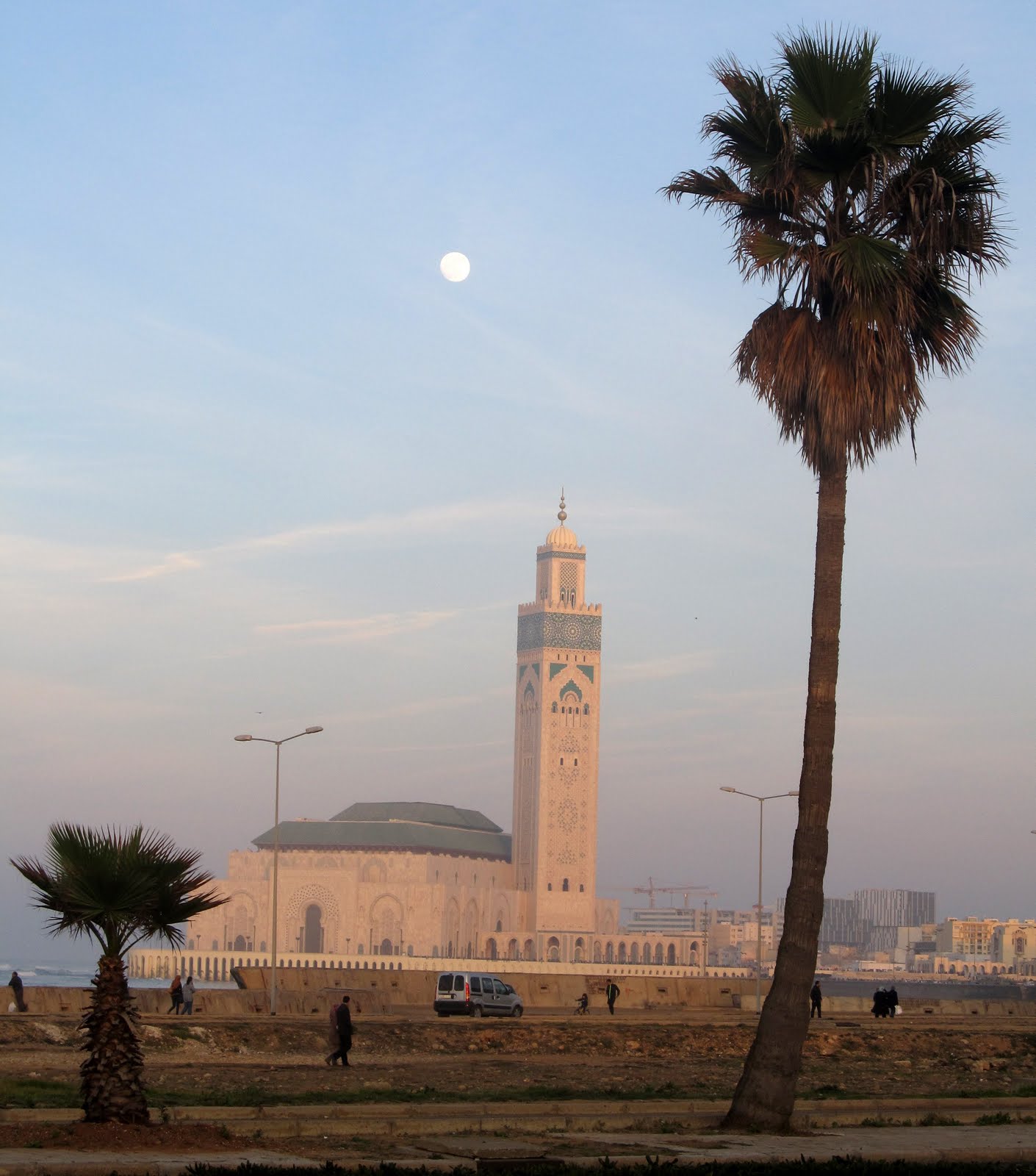
A trip to Casablanca is not complete without a visit to the Hassan II mosque. Completed in 1993, it is the third largest mosque in the world. It’s right on the ocean as a reference to a verse in the Qu’ran that says “The throne of God was on water.” The place itself is pretty stunning. It can hold 25,000 worshippers inside (20,000 men on the ground floor with space for 5,000 women in the mezzanines) and has a removable roof for sunny days. The basement has traditional hammams and the minaret is the highest one in the world at 200 meters. The whole place took only 6 years to construct, with 10,000 craftsmen and 2,500 builders working 24 hours a day in shifts. I’ve seen a lot of mosques between India and Morocco and I have to say that this one really deserves the attention it gets. (It's also one of only two mosques in Morocco that non-Muslims can enter).

The hammam in the bottom of the mosque.

View from across the water.

Between avocado juices (see below), we spent a few days roaming the Casablanca streets...

Two sick girls at "Le Petit Poucet" a Casablanca bar/cafe where Edith Piaf and Albert Camus used to kill time between flights.

Place Mohammed V

Exploring parks...

And art galleries...

And making copious references to the movie until I dragged Bree and Travis to Rick’s café which was, I must admit, a huge highlight of my time in Morocco.

(Just to be clear, all of Casablanca was filmed in Hollywood. The Rick’s Café in Casablanca was built a while after the movie’s release to mimic the one in the movie. They do an awfully good job).

Our "Sam" was actually named Issam.

(While we’re on this topic, let’s also be clear that “Play it Again, Sam” is never actually said in the movie).

I photographed just about everything in that building. Right down to the plates.

RICK'S cheesecake at RICK'S cafe

Bree & Travis had not seen Casablanca in full, so we spent an evening in our hotel room sniffling, coughing, and irresponsibly sharing a bottle of wine while I remedied this conundrum. We spent a long time discussing if it’s possible Isla still doesn’t love Rick but decided that’s not really what the film is going for, even if it’s the interpretation we would prefer.

It was quite sad watching the Casablanca tarmac on screen knowing that I’ll face that tarmac myself in a few days. (Or at least, the real version of that tarmac). It is with a melancholic, 1940s-style sigh that I tell myself, I may be heading to Europe, but we’ll always have Casablanca.