 Mysore's landscape from the top of B.R. Hills
I’m finding that in many ways, the giving of first names in India today is not unlike the giving of names in the U.S.
My new friend and Savithri’s sister, Kamakshi, told me that when she has visited Europe and the US everyone says to her, “Kamakshi is a lovely name, what does it mean?”
She tells them and then asks, “And what does your name mean?” Most often, the person who initially asked her the question replies with, “I’m not sure.”
In other words, many people have the assumption that because a name sounds “exotic” it
means something, whereas most Madisons and Matthews in the U.S. don’t know the meaning or origin of their own name.
After talking to many retired professors, linguists and academics around Mysore last week, I came to the realization that the specific meaning of names themselves is not actually what I’m that interested in. In their efforts to help, many of these academics tried to persuade me to embark on this project using their specific methodology. What I realized is that the linguistic origins of these names don’t really interest me. Instead, I’m finding that I’m more and more interested in the people behind these names, why their name was given to them, what a name reveals about the people who chose it, and, all in all, the meaning of a name in terms of the person who defines it.
In light of this realization, I’ve been phasing out a lot of these academic meetings in office buildings (although some have been undoubtedly helpful) and have instead been turning to the generous families I’ve already met here in order to listen to their stories. Sometimes the meaning behind Indian names can be vague or unknown, as they often are in the U.S., but one common thread is that most names here are chosen because they are found in the thousand names of Hindu gods and goddesses. This means that although names may not have distinct meanings in whatever language they derive from (Hindi, Tamil, Sanskrit, etc…), their origins can often be traced to a story.

Recently, I met Mr. R.G. Singh at a handicrafts store in Mysore and he has kindly given me permission to write about what I learned from him. Savithri, Kamakshi, Shilpa (a woman about my age who works at Kamakshi’s home) and I ventured out to join in one of the many Dasara exhibitions of dolls at his store. In light of the festival, he told me the story of the name Mysore, a story that explains how Dasara came to be the rich celebration that it is here. (Note: The origins behind the festival vary widely across India, across region, and even across who you’re talking to at the dinner table. Bear in mind this was his version of the story and there are many different ones).

At the Dasara doll exhibition
According to Mr. Singh, Mysore is actually an anglicized version of the name Mahaisahaooru which literally means “Mahaisa’s town.” Mahaisa was a demon who ruled this place. Mysore/Mahaisa is one of the few places in India named after a demon. As the story goes, Mahaisa had a bone from Brahma (the Hindu god thought to be the creator), and as a result he could not be killed. Mahaisa was terrorizing the entire village and no one knew what to do to make him stop. Finally, the goddess Chammundi was created. She is a goddess with 32 arms so she could carry a different weapon in each one. (Chammundi is also a form of the wife of Shiva, the destroyer). Chammundi created nine more “super goddesses” (as Mr. Singh called them) and they battled it out with Mahaisa for nine days. The problem is that Mahaisa had “rakthabeejasura” (“blood seed”) so that every drop of his blood that touched the ground would give birth to another demon. Because of this, there was no way to kill him without even more demons being created (Mr. Singh explained this as “cloning for demons”). What Chammundi (the super goddess) did was summon her sister, Jawalamalatripurasundari (a name which means “most beautiful woman in three worlds”). The resourceful sister spread her tongue across all of the village so that the battle could be waged. For nine days the super goddesses battled Mahaisa on the battlefield that was Jawalamaltirupurasundari’s tongue and at the end of it, she swallowed them all up so that not one drop of Mahaisa’s blood could give birth to more demons.

Hills of Mysore
Today, the nine nights of this battle (the “Navaratri”) are celebrated and the name Dasara refers to the 10th day on which Mahaisa was finally killed. During Navarati, most people in India worship Chamundi (also called Durga). The story is different in different places. Some people celebrate Navaratri because it’s believed that the goddess Parvarti balanced on the end of a needle to pay penance for nine days. Whatever the goddess and whatever the story, Hindus across India are worshipping the triumph of female deities. And whatever my own beliefs are, celebrating strong women is something I can get behind.

These women were thrilled to see me walking with my camera at B.R. hills. They insisted I take not only this picture, but also individual portraits of each of them.
Because Dasara celebrates the strength of female goddesses (in part), when relatives visit each other to celebrate Navarati, gifts are given to all the women present. As you can imagine, because the story of Dasara has its roots in Mysore, the celebration is at its most grand here. Kids have school off for all ten days and the palace of the former Maharaja (King) is lit up with more than 96,000 lightbulbs every evening. On Thursday, the day of Dasara, a procession will fill the city with elephants in costume, music , and fireworks.
Today is the sixth day of the Navaratri and yesterday was also a national holiday in order to celebrate what would be Mahatma Gandhi’s 143rd birthday. There is a lot to celebrate.

The temple of Chammundi, the highest point in Mysore proper.
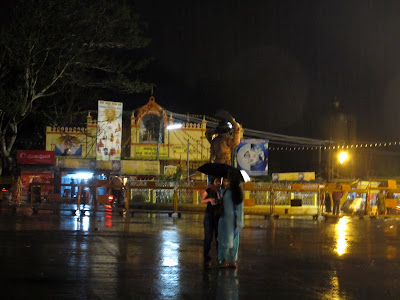
Chammundi Hill in the pouring rain.


 The park is one of India's best known protected areas and Tiger Reserve. Although I didn't see any tigers while there, the peacocks and elephants were pretty spectacular.
 This temple is located at the highest point of Bandipur National Park and is dedicated to Gopalaswamy (one of the names for Krishna).


 With a woman I met on the bus who wanted a photo together.

 Wild elephant spotting on the way back down.


 My personal favorite. I took a day trip with Savithri and Natarajan to see this. It was built in 1268 by the army commander Somanth. Due to a Muslim invasion in the century that followed, most of the statues and carvings now have their noses missing (symbolically thought to make it so that the Hindu deities can't breathe).

 The Middle panel shows a naming ceremony (the pregnant woman is in the center, and the cradle to her left).


 Bylakuppe is a Tibetan settlement about 2 hours outside of Mysore. The area was initially established as a place for Tibetan refugees in 1959 and today there are about 50,000 Tibetans living there. I visited with my friend Pushpa (the wife of a professor I was interviewing for my project) and she showed me around the gorgeous Buddhist temple.


 There is so much to see. (Excuse the photo overload).


