Wednesday, September 21, 2011

Next Steps

Bags are packed and I’m about to head outside my homestay to wait for the shuttle bus that will take me to the airport in Denpasar. Fully equipped with a Michael Cunningham novel I managed to find in the “for sale” pile at the Pondok Pekak library and the newish Fleet Foxes album. I’ll be getting on a plane at 4pm to Kuala Lumpur and after a brief layover, flying to Bangalore, India.

I’ll spend the night in Bangalore (what’s left of the night by the time I get in, anyway) and tomorrow I’ll be making the 3-hour drive to Mysore where I will be staying with an Indian family for a few weeks. In another small world connection, a colleague of my mom whose daughter I used to babysit for has family in India who has generously volunteered to host me while I’m there. I’ll be passed between their relatives in southern India for my first few weeks there (Mysore, Bangalore, Chennai, Hyderabad) before eventually making my way up north and flying out of Delhi on November 14th. At least that’s the plan.

I’m going to keep my eyes wide open on the way to the airport to soak up every last drop of this place. Thanks to my beloved friend and kindred spirit, Hadley Elizabeth Southall Roach, for giving me an anthem for these days:


Tuesday, September 20, 2011

Goodbye to Bali

People here tend to have trouble with my name. I’m mainly called “Nal” or some equivalent to that. I was absolutely shocked a few weeks ago, when driving along Tegallalung road to see the following:

I was as ecstatic as I was confused. I immediately wanted to find out the story behind this shop.

I’ve gone to the store three times in the last seven weeks. Each time I have had to bargain with a taxi driver to take me there (it’s too far to walk) and each time I've arrived, it's been closed. The shop seems to be permanently closed (at least it has been since I've been in Bali). I finally tried calling a phone number on a business card in the window and learned there are many ceremonies happening in the village of the owner, so the store is closed indefinitely.

I was frustrated. I had paid for drivers and gone all the way out there and desperately wanted to know the story behind this place. It seemed like such a sign.

And then, I finally accepted that there were no answers to be found. At least not by me, at least not on this trip. I was not going to be able to track someone down at the store, and even if I did, the chances were slim that the person working would know how the name came about.

I console myself by thinking that while it’s an amazing coincidence (or a sign?), I really should be learning my lesson from the people I’m trying to explain why I want to go there to. After bargaining for the price, I have been telling the drivers that I want to go to the store because my name is Nell. “The same as the store! My name Nell, store named Nell!” I try to repeat in Indonesian. “Yeah…” they often say and stare back blankly. After all, the driver’s name is Wayan or Made or Nyoman or Ketut. And there are shops called Wayan or Made or Nyoman or Ketut on every road.

Although I am terribly curious how a store called “Nell” (let alone “Nell: Parasite Wood Carver”) ended up in Ubud, Bali, I’m trying to tell myself that there’s a lesson to be learned from this. That perhaps there is value in recognizing that my name, like Wayan, Made, Nyoman and Ketut, will be spread and stretched independent of me. That a name is not about personal triumph or even individuality but is actually something that is shared. And that, of all of my conversations about names in Bali, is what I’m left with.

But I’m really going to have to get better at this whole goodbye thing. One of my earliest memories is of watching my (then) three year-old cousin refusing to say goodbye to everyone at a family gathering. She was convinced that if she hid in a room downstairs and didn’t say goodbye, no one could actually leave. That’s kind of my impulse right now.

At the same time, I’m ready to move on. While I think Ubud is the kind of place I would be happy spending many months, I’m also ready to push myself a little bit. The Watson (ingeniously) sends us off into the world with a postcard that reads, “Am I Getting This Right?” for us to refer to in times we feel particularly confused or aimless. (I’ve already pulled this out about ten times). It says that the point of this year is to “remove oneself from the comfort and stability of Home, exploring the world selectively in focused pursuit of one’s passion, and discovering along the way one’s potential for humane and effective participation in the world community. The Watson journey is a ‘solo’ experience, to be lived independently, but shared broadly with those who cross your path.” One of the ways it says you can tell you’re “getting it right” is if you’re “eschewing the known for the unknown” and “learning when to move on, leaving behind familiar faces in search of new friendships and opportunities.” It’s time.

The part that’s hard is thinking of all that I’ve done here in the past two months, all of the language I have learned, all of the people I’ve met, all of the connections I’ve made. And to think that in just about 24 hours, I’ll be back to being an ignorant tourist in a completely unknown place again. Exhausting to think about, but also humbling, and also completely thrilling.

And for now it’s time to say goodbye. Trying to express to people what they mean to you while dealing with a language barrier is probably one of the most touchingly painful things in the world. Yesterday Wayan kept calling me his “younger sister” and tonight I visited his house to say goodbye to his wife and daughters who presented me with a scarf. Kadek is insisting on cooking me dinner with her family tonight. As I was saying goodbye to Oka, he pulled out a mask he had recently completed. “For free, for free” he kept saying. “It’s a gift. Balinese angel.” I gave him a hug and cried the moment I got home.

And that’s what I’m doing in the world for a year. I’m making these attachments and then walking away from them. We had a running joke in my language class because whenever someone forgot the word for “alone”, I volunteered it. “Sendiri, sendiri!” I said. I had been using that word so frequently here it quickly became second nature. “Sendiri” quickly became “Nell’s word.” When someone couldn’t remember it, Nyoman (my teacher), would say, “Alone! Alone! Remember, this is NELL’S word.” This is either terribly hysterical or terribly depressing depending on my mood.

Sendiri again. But leaving Bali with so much more than I came with (and not just in the sense my already overstuffed suitcases will be stuffed even more…that is, once I actually pack them). Terima kasih, Bali. Terima kasih banyak.

Note: Most of the photos above were taken at a cremation procession on the street where I live on 9/17/2011. I got up from my sick bed in my middle of the afternoon, stepped outside, and saw THAT.

Monday, September 19, 2011

Missing Madame Barbara

I am, unfortunately, down to about 40 hours left in Ubud. I would like to say I'm taking long romantic walks in rice paddies and swims in the ocean as a way of saying goodbye, but in truth I've mainly been running around like a mad woman--faxing my health insurance company, doing laundry, packing, catching up on skype dates while I know I have internet, and running around town saying my endless goodbyes and thank yous to the people who have made my time here so memorable.

I do have an hour reserved tomorrow for something I've been waiting to do for a long time. Ubud is sort of surrounded by magic. Not only is it notoriously a place of healing, but there is an entire religion and culture built (partially) around protecting people from evil spirits, watching performances based around the idea of trance, and calling on ancestors from the dead. For a usually skeptical person, I have been proved wrong time and time again when so many things here just seem too coincidental to be entirely random.

Some of you may smile reading this because I've often talked about wanting to see a psychic. I think it started when I was about seven years old and went through a phase where I was really convinced I was psychic because I sometimes guessed days of the week correctly. (Maybe every kid goes through this phase?) I've gotten as close as walking into a psychic's office and have always decided not to. I am a dangerous combination of being extremely skeptical and extremely sensitive, as in, "I think all of this is absolutely false and purely psychological but I WILL BELIEVE ANYTHING YOU SAY TO ME!" Knowing this about myself has been reason enough to stay away. At least so far.

Many many travelers come to Bali to meet with balians and psychics and healers. And after doing some research about people in the area, and already making several appointments and chickening out, I am booked for 3:00pm tomorrow. Because, when in Rome...

The rational part of me is already laughing at myself and the other part of me is so nervous about what she might say that I might not be able to sleep tonight. What I recently remembered, however, is the video below, which has become famous with my close friends and family. There are a lot of things my parents got really really right when my sister and I were growing up, and one of those things were birthday parties. Having a former teacher turned education professor for a mom means that your birthday parties were at home, built around a theme of your choosing, and had scheduled activities to make sure the two hours didn't end in sugar-high kids having melt downs. At one of these events, the "magic party" for my 6th birthday, my grandmother dressed up as "Madame Barbara" and told fortunes. I think the video says a lot about how this went over.

I think Madame Barbara may have inspired tomorrow's event. And although I really hope the psychic tomorrow does not also tell me I'll be having five children, I'm willing to say that Madame Barbara was right about a lot of things. Tomorrow's psychic has some competition.


p.s. Happy late birthday Grandma!

Saturday, September 17, 2011

Bali: More Impressions

Thanks for all of your well wishes. Yesterday’s blood tests reveal my cell counts are returning to normal, meaning the antibiotics are doing their job and there’s no need to do further tests. I’m feeling much much much better and have been fever free for more than 24 hours now. I’m currently celebrating with a mango lassi that comes with an internet connection at a place down the street.

I was recently reminded I had written a post when I first arrived about my first impressions of this place, and I realized there are a few things about daily life here I’ve been meaning to write about but haven’t yet. Stuck with a few days in bed, I decided to write these things down now (bear with me, it’s a long one). Calling this “last impressions” sounds too fatalistic, so for now, we’ll just go with “more impressions” and postpone the goodbye for later this week.

FOOD: One of my favorite parts of travel, and surprisingly, something I haven’t written much about yet. You can basically find any kind of food that you want in Ubud. Exhibit A:
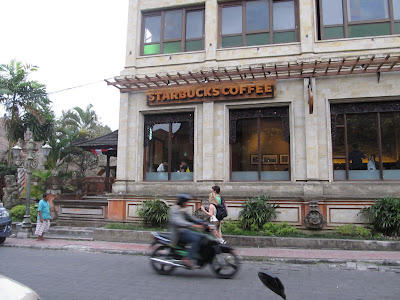
Note: I have yet to step inside this building, but I do get a kick out of the wood carved Starbucks sign. (Stop pretending. No one believes you're local, Starbucks).

There are western-style restaurants for tourists right next to food carts that most locals frequent. If I give into my craving and get an iced coffee at a western style café and use their internet, an hour later I can get an entire dinner for less than the price at a local food stand.

Balinese/Indonesian food seems to be a convergence of cultures. It’s a blend of many different Asian dishes thrown in with some “Ayam Goreng Kentucky” (Kentucky fried chicken). People here love fried chicken. Below is a typical buffet meal with some really popular dishes (this is what my homestay family served at a birthday party):

From left to right: Bakso ayam (chicken meatball soup), ayam goreng (fried chicken), ikan satay (fish satay) mie gorgeng (fried noodles) and nasi putih (white rice).

Bakso ayam (chicken meatball soup) is also a really popular snack on its own and is sold by vendors on the street.

Some other popular meals:

Gado-Gado. Every visitor’s favorite local dish. Mixed vegetables smothered with a rich peanut sauce. Served in every warung here. Also I recently learned that while “gado gado” is a food, it can also be used to mean “mixed.” So if someone asks what nationality you are, for example, and your family is from multiple countries you can just respond, “gado gado.”

Nasi Campur is also on every menu. Pictured above is “nasi campur” from a restaurant (with a little nicer presentation than is normal, but it gives you a sense of it). Nasi campur implies rice, vegetables and usually a mix of main dishes like chicken, tempe, tofu and egg. In the photo above is: egg, vegetables with a coconut sauce, fried chicken (of course), a corn fritter, perkedel (fried potato), tempe, peanuts and tofu.

On the side, you might notice the two small dishes—the ubiquitous sambal. Balinese food itself isn’t that spicy, but it’s the sambal that makes it so. I’ve come to love it, especially the “sambal balado” (pictured on the bottom, with onions and chilies).

The picture above is of a typical local food place where you’d go in and just point to what you’d like to eat. Buying food wrapped to go (in paper or banana leaves) is also big here.

A typical lunch from a street cart that's been wrapped up in paper: fried egg, fried rice, a prawn cracker and of course, some sambal (in the plastic bag):

There are some other (more eccentric) meals I’ve experienced here including lawar (a celebratory dish made with spices, pork and pig’s blood-- I had the unfortunate experience of discovering this only after I ate it), babi guling (suckled pig), and oxtail soup.

Also, the fruit! Oh the fruit. For a Vermont girl, having a mango whenever I want it for approximately 30 cents is a dream come true. And then there’s mangosteens and snake fruits, things I had never tried before but have fallen in love with. And then there’s fresh juice from any fruit I want! And the smoothies! Just don’t make me eat the durian.

Also, sugar. There is so much sugar here. When Kadek at my homestay makes me western-style scrambled eggs, she puts sugar in them. My first few weeks when I ordered any kind of tea or coffee anywhere I could barely drink it because it was so sweet, and now anything remotely unsweetened that I get at western cafes I have to add sugar to.

As my language teacher once put it, “I don’t understand. All of you say things are too sweet here. But then you also say they’re too spicy. In the west, food is not sweet AND not spicy?” She has a valid point.

HUMOR: The humor here took some getting used to. People laugh at everything. Namely tourists who are trying to cross the street. Situations that would not at all be funny to people at home are hysterical to people here. My language teacher told me a story of her friend who was teaching an Indonesian language class when a girl stepped outside to take a phone call. She came back in tears because she got news from her family in England that her cat had died. The Indonesian teacher had burst into laughter. She had no idea that a cat’s death would be considered a sad thing. Similarly, my homestay family made jokes with me that I had no idea how to interpret initially. One night, Nita (the 16 year-old) came up to me and said, “Nell, I sleep in your bed tonight, okay?” “Umm…okay…” I told her, trying to figure out what kind of communication barrier we were dealing with. She never came upstairs, but this question continued for a few days, “Nell, can I sleep in your room tonight?” Made, her father, started to say the same thing. I brought it up in my class and my teacher explained that this was a common joke here. It was just a way of being funny. I tried to explain why, in the United States, a forty year-old man saying, “I sleep in your bed tonight, okay?” would be super inappropriate and super not funny.

TRAFFIC: This has definitely taken some getting used to (see above about crossing the street). No rules seem to apply here. Too many cars in your lane? Use the other one! Traffic jam? Take your motorbike on the sidewalk! No helmet? Use the route where there are no police! Also honking implies something totally different here. Instead of it indicating the error of another driver, it just means “I’m here!” People honk whenever they go around curves here, they honk whenever they think someone might not see them, they honk whenever they make a turn that they can’t see the other side of. Basically, it’s a free for all, and you keep honking and hoping the other drivers will hear you and stay far enough away.

DOGS: The state of stray dogs in Bali is absolutely abominable and so heart breaking. Everywhere you walk there’s a dog, usually clearly diseased and limping and who lives on the street. There are several shelters that have recently been set up in Ubud to try to remedy the problem, but it seems like it’s an issue on a really massive scale. They also can be really dangerous because a lot of these dogs fight with one another, and people walking by can inadvertently be bitten. (And I do know it's sort of naive to be writing about dogs in a place where there are also a lot of people living in extreme poverty, but that's another issue...)

EAT PRAY LOVE: I actually think the hype around the book was probably much bigger a year or two ago. Still, everyone knows of the book here, and some love it and some hate it. When I tell people I’m going to India next, the most common reaction I get from people (most often other western travelers) is, “Oh, Eat Pray Love in reverse?” Places here do try to get every penny they can as a result of that book, and driving around Bali there are often signs saying, “Eat Pray Love Movie Spot” to indicate landscapes where the movie was filmed. Gift shops will sell metallic frames or towels with the words “Eat Pray Love” all around them. A lot of the sights used in the movie don’t actually exist, but the people do. Although I have not paid him a visit, Ketut Liyer does not live too far from me. I don’t think he’s missed my business. My teacher told us that since the book came out, he’s been making 7 million rupiah a day (the equivalent of about $800). A lot of locals here believe that it’s gone to his head and now he tells every woman who comes to him the same thing.

KUTA COWBOYS: Are a real thing! One of the dozens of reasons I've stayed away from the major tourist-district of Kuta. For anyone who wants to watch an interesting documentary with beautiful shots of Bali, I'd recommend "Cowboys in Paradise" (released in 2010). I recently watched it and it gives an interesting (if not overly simplistic) picture of the impact of the tourist industry on Balinese local life.

PARENTING: I find parenting absolutely fascinating because parents here seem to be the complete anti-Tiger Mothers. Kids in Bali are absolutely spoiled. They can sleep whenever they want, eat whatever they want, and are never disciplined, even when they do something wrong. I have seen a three year-old boy yank actual strands of hair out of a four year-old girl’s head while she wailed and when they were finally separated, his uncle kicked around a soccer ball with him. Nothing was said about what happened.

From an American approach, it is kind of amazing to me that there seem to be no consequences, but as someone pointed out to me, no Balinese man is going around pulling strands of hair out of people’s heads, so somehow, without being told, kids learn not to. It seems so obvious, but also such a different philosophy.

If you are young or old in Bali, you are thought to be closer to the gods and because of that, you are thought to be precious. All of Bali essentially acts as a babysitter. Because most families live with grandparents, aunts, uncles, siblings and cousins, it is just assumed that wherever the child is in the house, another person will be there. On the street, children are collectively smiled at, collectively fed, collectively watched. No one seems to worry about where their child is because there is the assumption that they will be taken care of by someone, even if it’s a stranger.

KIDS: One thing I absolutely adore is watching the rapport between kids here and the physical affection, specifically. I see kids walking to and from school all the time here and most often (regardless of age, regardless of gender), they are linked arm in arm or holding hands. Watching pairs of nine year-old boys in their school uniforms holding hands and walking down the streets is one of my favorite sights in the morning.

Even cuter: as part of the girls’ uniforms at most schools they require that they wear two braids in their hair. The color of the ribbon that they put at the end of the braids is to indicate what grade they’re in.

Yet still cuter: On the days of the full moon, kids get to be uniform-free.

Friday, September 16, 2011

Musings from the Sick Bed

I could have predicted that at some point during my Watson year this would happen, but I was hoping it could at least wait for a while. Wednesday I had been feeling a little off and sure enough that night I slept terribly and kept waking up with chills or hot sweats. By morning, it became very clear to me that I had a high fever. Poor Kadek came upstairs in the morning with her usual, “I make you breakfast?” And all I could say was, “Tidak. Sakit.” (No. Sick.)

If I am going to get sick during a year completely on my own, I guess it’s good it happened in a place that I know pretty well already, around people I know pretty well already. Made plopped me on a motorbike (103 fever and all) and took me to a nearby clinic that I had looked up online. Because I had a case of strep throat in early July, they did a test for that and also took some blood to rule out other possible illnesses. They put me on a broad spectrum antibiotic, fever reliever, and pain reliever for my sore throat.

The Doctor called with some results of yesterday’s blood test and wanted me to come back today for more tests due to a white blood cell and neutrophyl count that was double the normal amount (whatever that means). Because as my doctor said,” In tropical climate, could be many things wrong.” They should call in a few hours with the results of today’s tests, and to make sure that the antibiotics are continuing to do their job. In the meantime, my temperature has been rapidly improving. The Doctors are still not entirely sure what’s wrong, but they know it’s a bacterial infection rather than a viral one and things are definitely looking up (as evidenced by the fact I’m even writing this).

Dealing with this in Ubud is obviously not ideal. The man who took more blood this morning stuck the needle in my arm and then decided my vein was too small. He decided to switch to drawing blood from my hand instead. “Wow,” I said, “I’ve never had blood drawn from my hand before. Will this hurt?”

“Yes.” He said, and then put the needle in.

But although language barriers and different medical care makes this more difficult, there is also a level of individual attention and trust here. The Doctor personally called me last night (and then texted me when I didn’t initially pick up) with the results of my test. They let me leave the clinic without paying because they would call my international health insurance company (thank you Watson) to try and get the visit and medicine fully covered. They have a sign in their office that reads, in broken English, “Customer! You cannot tell s ccess without U!”

And while there is, undoubtedly, nowhere I would rather be than in my own bed in Burlington with some of my mom’s chicken soup, and even typing that is making me tear up right now in my feverish state, I am trying to be grateful. Grateful for clinics with bilingual doctors and grateful for health insurance. Grateful for medicine and grateful for a (usually) healthy body. Especially grateful for the old Friday Night Lights episodes I discovered were saved on my computer that have now occupied the last few hours of bed rest. (And let me tell you, there is great culture shock to be found from watching a show about Texas football in Ubud, Bali). Grateful for Made for taking me to the clinic two days in a row and grateful to Kadek for bringing me fruit and porridge. They have been so so kind to me.

This just not quite how I envisioned spending my last week in Bali.

Monday, September 12, 2011

Name Post: The Sipu of Padang Kerta

Gusti had mentioned to me in passing that he has an uncle who lives in the village of Padang Kerta who is a former village leader and priest. His uncle, referred to as “Sipu” (meaning “Master”), is present at all of the village ceremonies and people come to him whenever they need advice. Thinking that it would be informative for my project to meet someone who helps channel the spirits of ancestors in order to choose names for babies, I asked Gusti if I could pay the Sipu a visit.

As things seem to go here, my intended Bali coffee date with the Sipu spiraled into a weekend- long affair. Still sore from Batur, on Saturday I embarked on the two hour motorbike drive there with one of Gusti’s brothers. Padang Kerta is a quiet and traditional village in the Karangasem region. It is one of the few places left in Bali where people eat collectively and all share one plate together. It is also one of the few places where most people don’t speak Indonesian, but different forms of Balinese that vary across caste. Gusti has four brothers and many nieces and nephews, all of whom were incredibly generous in opening their home in Padang Kerta to me. We spent the day at the wedding of one of Gusti’s cousins, visiting the water palace Tirta Gangga (a sacred site for Balinese Hindus that was supposedly built in 1946 by the King of Karangasem), looking out on some beautiful rice paddies in the area (Gusti’s twenty-two year old nephew told me this was his favorite spot to sit and think), haggling to get me a room at a homestay/motel nearby that had never had a westerner stay there and cost the equivalent of $7 (this involved several phone calls from the owner of the homestay to Gusti’s family saying it was okay, I was with them, and there would NOT be a man in the room with me), playing with Gusti’s many nephews, and discussing stereotypes of European tourists over fried fish.

And then, finally, I met the Sipu of Padang Kerta. Gusti told me to come prepared with a list of questions and we all sat around the Sipu’s family temple with some of his eleven grown children drifting in and out and helping to translate the high-caste Balinese that the Sipu spoke.

I learned that in Padang Kerta the method of using incense to choose a name isn’t practiced. Instead, when the mother is pregnant, an elder (like the Sipu) determines who the baby will be a reincarnation of. The Sipu told me a story about one of his own eleven children. When his wife was pregnant, she talked in her sleep about her mother who had passed away a few years ago. As a result, when the baby was born, they decided his real name (fourth name) should be “Wira”, which, according to the Sipu means “calm.” The mother the baby is a reincarnation of was apparently a very calm person, and the baby’s name should reflect her spirit, just as the baby himself does.

Tika jumped in with a story about her youngest nephew, Danu. It is said that Danu is a reincarnation of one of Gusti’s brothers who died in a motorbike accident in Germany. His family had a feeling when his mother was pregnant with Danu that he would be a reincarnation of this brother. Sure enough, when the baby was born, he looked uncannily like Gusti’s dead brother. And, perhaps even more eerily, when the baby is upset, all you need to do is play the song Mr. Jones by Counting Crows and he will immediately stop crying. No other song seems to work. Mr. Jones was Gusti’s brother’s favorite song.

In Padang Kerta, unlike some other villages, before the baby is given a name at the three month ceremony, they are not referred to as “I Barat” (blood) but instead are given a nickname according to their personality or physicality. The Sipu said nicknames like “Tiny” or “Noisy” or “Chubby” were common.

I also talked to the Sipu about what happens if a name is wrong for a person. As I’d heard elsewhere in Bali, this happens all the time. If a child is unusually aggressive or frequently falls ill, parents will come to the Sipu. The Sipu will go into a trance and call upon the ancestor who the baby is a reincarnation of. This ancestor will then speak through the Sipu. One of the first questions the Sipu asks is if the baby is acting out because he or she is being called by the wrong name.

The Sipu told me a story about his niece who was named “Rati” which represents the moon. She was getting sick frequently, and the Sipu channeled the deceased relative she is a reincarnation of and through that spirit, suggested her name be changed to “Ratni”, meaning “flower.” The Sipu believes the name Rati is “too heavy” a name for a child. He doesn’t like names like Rati or Bintang (meaning “star”, and also, unfortunately, the largest brand of beer in Bali) because he believes these cosmic names are putting people “too close to the gods.” The name “Ratni” helped plant the girl’s feet on the ground and was a more humble name.

The Sipu also talked to me about caste names. He told me that the caste names used by royalty (“Anak Agung” ) are actually at the same level as those who use family names, like “Gusti.” The difference is that apparently “Anak Agung” was a prefix given by Dutch colonists meaning “great man/man of honor.” He said that these names were given by the Dutch to certain Balinese people who aided them as a way of honoring them, and, as the Sipu aptly pointed out, getting them to cooperate. Today, you can tell if someone uses that prefix, their family did not fight against the Dutch

I asked the Sipu, out of curiosity, why he thought Balinese people are able to maintain such a strong and distinct culture despite increasing technology and masses of tourists. He told me that he thinks it's simply because of karma. The Sipu says that because Balinese people so strongly believe that their current actions will have a direct influence on who they are reincarnated as in their next life, they feel the desire to go to ceremonies, to give offerings and to act respectfully.

I thought about this on the ride home, as Gusti’s brother stopped along the highway to make an offering for a safe journey. I thought about this when I got back to Gusti’s compound and saw that his family was having a ceremony to bless their new motorbike so that it would carry them safely from place to place. I thought about it when I was a woman’s first customer at the market and she touched the money I handed her on all of her goods as a way of bringing luck to her sales for the rest of the day. I wonder if there is a way of inspiring people to show respect for one another and for the environment around them even without a unifying religious influence.

Before I left, the Sipu wanted to know what my religion was. I was ashamed to admit that I didn’t identify with any religion in particular. I told the Sipu I wasn’t sure how to explain what I believed exactly, except that I believed in the power of other people, our relationships with each other, and the immense capability of the human heart and the human mind. As one of his sons translated this, I nervously awaited his response. To my surprise, the Sipu smiled. His son translated. “He says that’s good. He said that religion isn’t the point. It’s all about your heart and having respect in your heart. Having a religion and believing in gods is just a way of finding that. It doesn’t matter how you get there.”

Sunday, September 11, 2011

Team Obama Climbs Mt. Batur

I will readily admit that, like most of the rest of the United States, I fell hard for Barack Obama. I cried at his speeches, got to vote for him in my first time ever voting in a presidential election, campaigned for him, braved the crowds in DC to watch him be inaugurated, read his autobiographies and, as a result of his efforts, felt pride for my country in a way I never had before. The song by Michael Franti & Spearhead that Obama inspired became a sophomore year favorite, and my love for it was only increased when it was featured in a Swarthmore step aerobics class. Kicking and jumping and generally making a sweaty fool of myself with friends to cries of “Yes We Can” was probably the only way I got through an otherwise tumultuous sophomore year (I’m looking at you, HR).

I was thrilled to find that a slightly obsessive, unconditional love for Barack Obama was something I had in common with most Balinese people. Upon saying you’re from the United States, the common reaction you get here is, “Oh! Obama land!” Because of his Jakarta connection, people here seem to adore him. It is not uncommon to walk into an Ubud artist’s gallery and find traditional Balienese paintings of rice fields and beaches and flowers next to a life size portrait of Barack and Michelle at the inaugural ball.

A few days ago, I became even more a part of “Team Obama.” I had been talking with some other travelers in Ubud about splitting the cost of a guide and driver to do the infamous hike up Mt. Batur. To my own good fortune, and my aching thighs misfortune, this idea materialized on Friday.

Mt. Batur is an active volcano that sits on a lake in the northeast part of Bali and is a popular destination for brave (or crazy?) travelers like us who are willing to climb up in the dark to see the sunrise. By 2am six of us were huddled into a car and driving away from Ubud to get to the mountain. There was un unmistakable Christmas-morning kind of mystery as we surreptitiously met up with our flashlights and fleeces while the rest of the city was asleep. Around 3am we got to the base of the mountain and stopped for some banana pancakes and coffee.

When we got to the base of the mountain, we met our guides, Ketut and Komang who would help lead us up. Although Batur is a non-technical hike, and not too difficult if you’re in decent shape, it is a volcano, and in recent years a few tourists have lost lives falling into the larger craters (I’m only admitting this to my mother now that the hike is over). All things considered, it’s good to go with guides (and they are more than happy to take your money to do so).

Ketut and Komang were very excited that five of the six of us were from America and promptly decided to refer to us as “Team Obama.” They loved the Michael Franti song and would yell the chorus from the mountain at various intervals. For the most part, the rest of us were too breathless and sweaty to sing with them for long.

After two hours of some exhausting climbing in the dark, we reached the top where groups of tourists were gathered waiting for the sunrise. Unfortunately, we were met by a very cloudy sky. Komang and Ketut made us banana sandwiches and eggs by cooking them in steam coming from a volcanic vent. When finished, they broke through the crowds with a massive tray for us yelling, “Breakfast for Team America! Obama breakfast!” (We may have been a little unpopular with the other tourists).
Just a monkey hanging out on top of a volcano.

Little bit of sun coming up.

The (foggy) inside of the largest crater.

We stayed at the top for a while and explored there, wandering around some of the largest craters and feeling the steam coming out from the volcano.

And then, on the way back down, the sky opened up. For the first time, we could see where we were and what we had done.

(All the black rocks are from when the volcano erupted in 2000!)

And although the hike really had nothing to do with my project, in retrospect, there is a way of looking at names themselves as a common language. Because whatever the name Barack Obama connoted to me in my sophomore year of college as my friends and I rocked out to Michael Franti & Spearhead, it connoted something similar to Ketut and Komang. I know this is more about Obama’s values and personality than his name itself, but because of him, his name will always have these connotations. He is an example of someone who has so clearly given a name such a distinct personhood and its own definition. His relationship with his name has always been interesting to me as the former Barry, now turned Barack, struggled to be popular with Americans despite an unpopular American name. The outrage many Americans had upon learning his middle name was “Hussein” was fascinating to me as I watched how names themselves (even middle names) can have such strong connotations that lead to prejudice and ignorant assumptions based on title alone. But just as his name has carried skepticism with it, it has also carried so much joy. If Kenya were not currently on the state department warning list, I would love to visit this year and meet all the three or four year-old Barack Obamas who are toddling around in the wake of his election.

And although my opinion of Obama today is not quite as overwhelmingly positive as it was during his election, it seems to me that because of the values and beliefs his name now carries with it, “Obama land” actually stretches far beyond the borders of the United States.

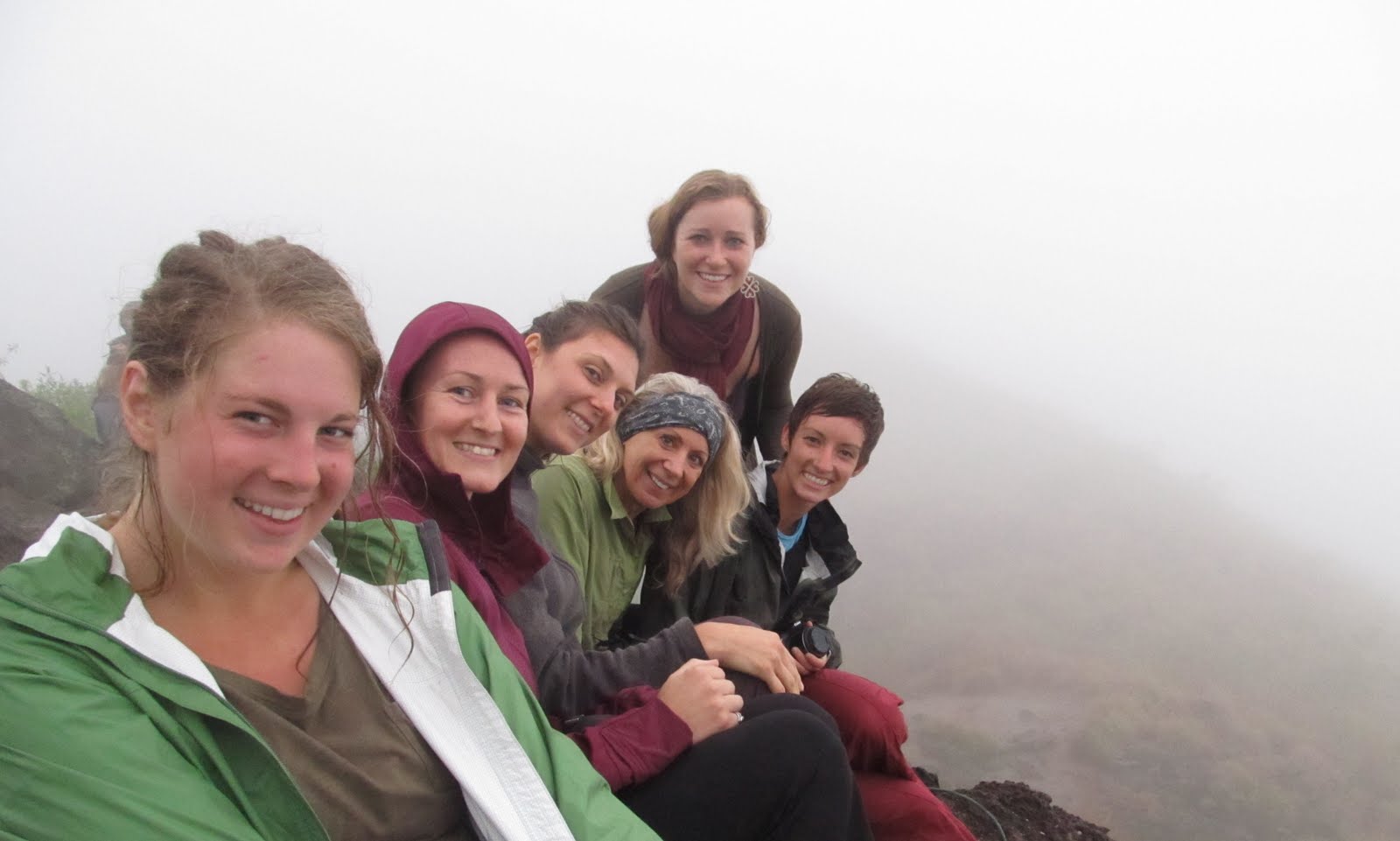
Triumphant at the bottom.

Team Obama was back in Ubud by eleven. Yes We Can.